Set the spoiler boundary before the first question
Ask whether the discussion covers the whole book or stops at a particular chapter. State that boundary clearly at the start, including for people joining online. If some members have not finished, agree on what they prefer rather than silently assuming they want to hear the ending. A simple first half without spoilers followed by an optional full-book conversation can work.
Mark your prepared questions with the chapter or section they concern. This helps you avoid introducing an ending question too early. For nonfiction, the boundary may be a set of chapters or an argument that appears later. A considerate discussion gives people enough information to decide whether to stay for the next part.
Begin with a question everyone can answer
Open with a reaction that does not require detailed recall. Ask which part held someone's attention, which passage slowed their reading, or what they expected from the opening. Members who listened to the audiobook or finished several weeks ago can still join. You are inviting observations, not checking whether people memorized names and page numbers.
Use a short round if a few voices tend to dominate. Each person can offer a sentence, and passing should be allowed. Then follow an interesting thread. A round is a way to open the floor, not an obligation to deliver a polished opinion. People often discover what they think while hearing someone else's response.
Ask about choices instead of asking for the correct answer
For fiction, try asking which decision changed a reader's view of a character, or what another possible choice would have cost. For nonfiction, ask which claim felt most convincing and what evidence shaped that reaction. Questions framed this way encourage disagreement without implying that the organizer possesses the approved interpretation.
Prepare a follow-up such as 'What led you to that reading?' or 'Did anyone understand the scene differently?' Give people time to think before moving on. Avoid stacking three questions into one long speech. A single clear prompt is easier to answer and lets the group decide which part deserves more attention.
Bring setting, structure, and language into the conversation
Character questions can fill a whole meeting, but the book's shape offers other routes. Ask what changed because of the setting, how the order of events affected suspense, or where the pacing felt deliberate. With nonfiction, discuss how the chapters organize the argument and whether a different order might have changed your understanding.
If you want to discuss a short passage, note its location and ask members to find it in their own editions. Page numbers vary. A chapter reference plus a brief description is often enough. Avoid printing long copyrighted extracts on your worksheet. Your own question about a passage can guide the conversation without reproducing it.
Leave room for disagreement and personal boundaries
A good discussion does not require agreement. Invite members to talk about the text and their own reading response rather than telling another person what their reaction should be. If a topic becomes heated, summarize the different views and return to the question. The aim is understanding, not persuading every reader to share one rating.
Some books raise private or painful subjects. Do not require people to connect the story to their own experiences. They can discuss the author's choices, stay general, or pass. If you expect a sensitive topic, give a brief heads-up before asking about it. Thoughtful hosting makes participation possible without making disclosure a condition.
Choose fewer questions than you think you need
Five or six flexible prompts can be enough for a lively meeting. Keep two extras in reserve, but do not rush through the list to finish the worksheet. If a question starts a useful exchange, let it breathe. Write down one unexpected point so you can remember what the group actually discussed.
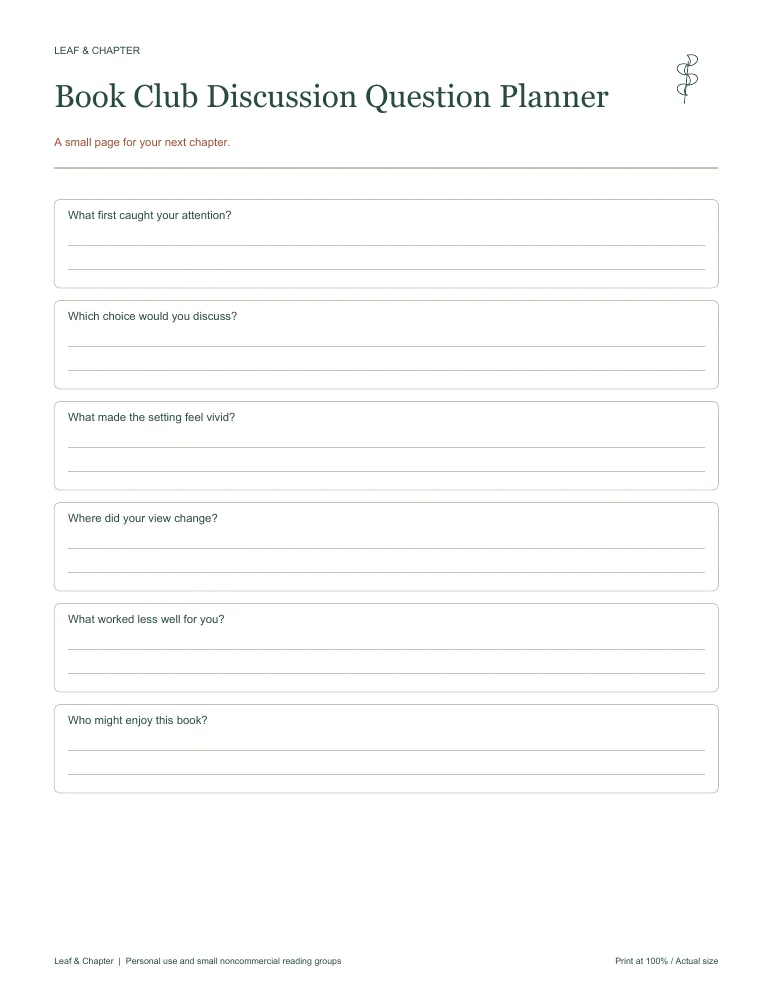
Use the printable below to choose your opening, a few deeper prompts, and a closing question. A closing prompt might ask whether anyone's interpretation changed during the meeting. That ends the conversation with reflection rather than a vote about who was right. Save unused questions for a future book or another group.
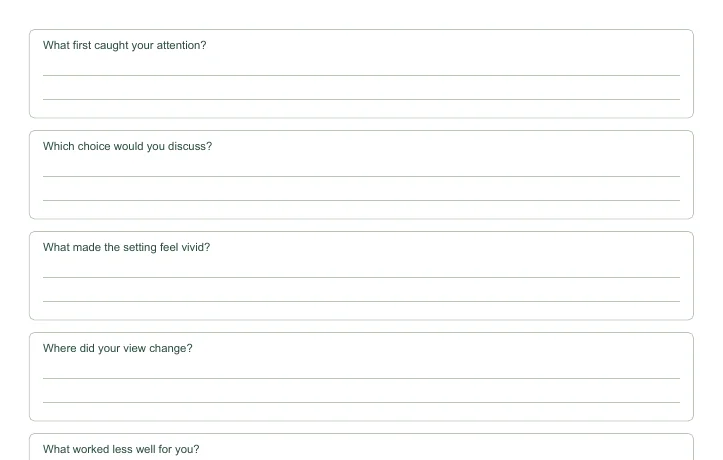

Book Club Discussion Question Planner
Choose the paper size that matches your printer. Both PDFs are free, undated, and made for personal use.
PDF format · No signup · Print at 100% / Actual size
Need a hand? Read the printing guide. These are print-and-write pages, not fillable forms. Personal-use license.
Save it for your
next bookish day.
Keep a link to this page so the printable is easy to find again.
Save to Pinterest ↗A few questions before you print
How many questions should I prepare?
Start with five or six, plus a couple of backups. The pace and size of your group will determine how many you use.
Can these prompts work for nonfiction?
Yes. Replace character choices with claims, evidence, structure, and the questions the author leaves unanswered.