Make the shortlist small enough to compare
Three to five titles are usually easier to consider than a long collection of suggestions. Ask for nominations by a deadline, then narrow them using the club's agreed criteria. Those might include reading length, genre rotation, library availability, and the meeting date. Explain these filters before applying them so members understand why a suggestion may wait for another month.
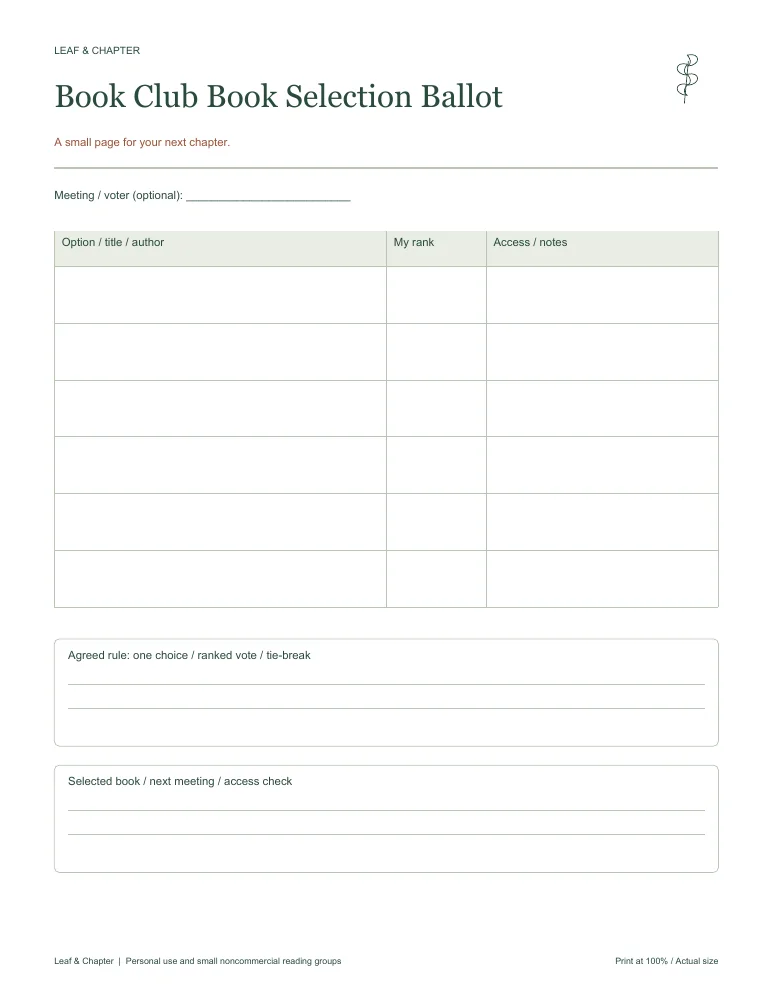
For each candidate, supply the title, author, a short neutral description, and a rough length. Check print, ebook, and audiobook availability if those formats matter to members. Avoid writing a glowing paragraph for your favorite and a bare title for the others. Comparable information makes the ballot more useful and the decision feel less steered.
Choose a voting rule before collecting votes
The simplest rule is one member, one vote. Each person selects the title they most want to read, and the option with the most votes wins. That is easy to explain and count. If your group wants more nuance, ask members to rank a small shortlist and state exactly how those rankings will be counted.
Do not improvise the counting method after seeing the results. A points system, a runoff, and a single-choice vote can produce different outcomes. For an informal club, simplicity is often more valuable than a complicated formula. Write the chosen rule on the ballot or in the accompanying message so members do not have to infer it.
Give people a real chance to participate
Set a deadline that suits how the group communicates. A vote at the end of a meeting may exclude absent members, so consider accepting replies for a few days afterward. Explain whether the ballot is anonymous or named. If using paper anonymously, provide a collection method that does not require members to announce their choice.
Allow one response per member and choose a single place to collect it. Votes scattered across text messages, paper slips, and several conversations are easy to miss or count twice. If a person changes their vote before the deadline, decide how you will replace the earlier response and communicate that rule consistently.
Plan for ties while nobody has a stake in one
A tie is less awkward when the club already knows what happens next. You could run a brief second vote between the tied titles, select the book with better access for the group, or use a transparent random draw. Choose one method in advance. Availability is a sensible criterion only if you have agreed to use it.
For small groups, a conversation may resolve the tie quickly. Still, avoid letting a confident member turn that conversation into pressure on others to abandon their preference. The outcome does not need to please everyone every month. A predictable process and a record of past selections can help the club rotate fairly over time.
Check the winner before announcing the schedule
Once votes are counted, confirm that members can obtain the book within the reading period. Availability may have changed while voting was open. If an unexpected obstacle appears, explain it and use the fallback your group agreed on, such as choosing the runner-up or moving the meeting date. Do not quietly substitute another title.
Share the result, the meeting date, and the reading boundary in one clear message. If voting was anonymous, report totals rather than individual choices. Keep losing nominations on a future list if members still want to read them. A book that did not win this month does not need to vanish from consideration.
Use the ballot as a small piece of club memory
Save the final shortlist and result alongside the meeting notes. Over several months, you may notice that the club keeps choosing one genre or avoids books that are difficult to borrow. That pattern can guide future nominations without treating every vote as a referendum on someone's taste.
Download the ballot below, add your candidates, and include the rule and deadline when you distribute it. If the process feels cumbersome after a few rounds, simplify it together. The ballot should reduce administrative friction so the group can return to the enjoyable part: reading something worth discussing.
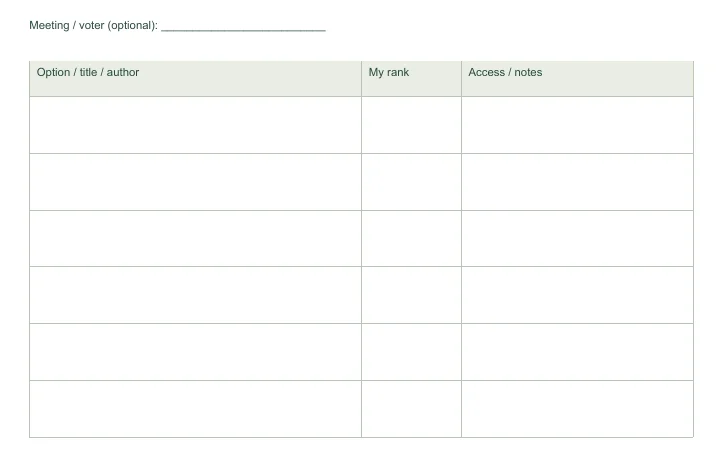

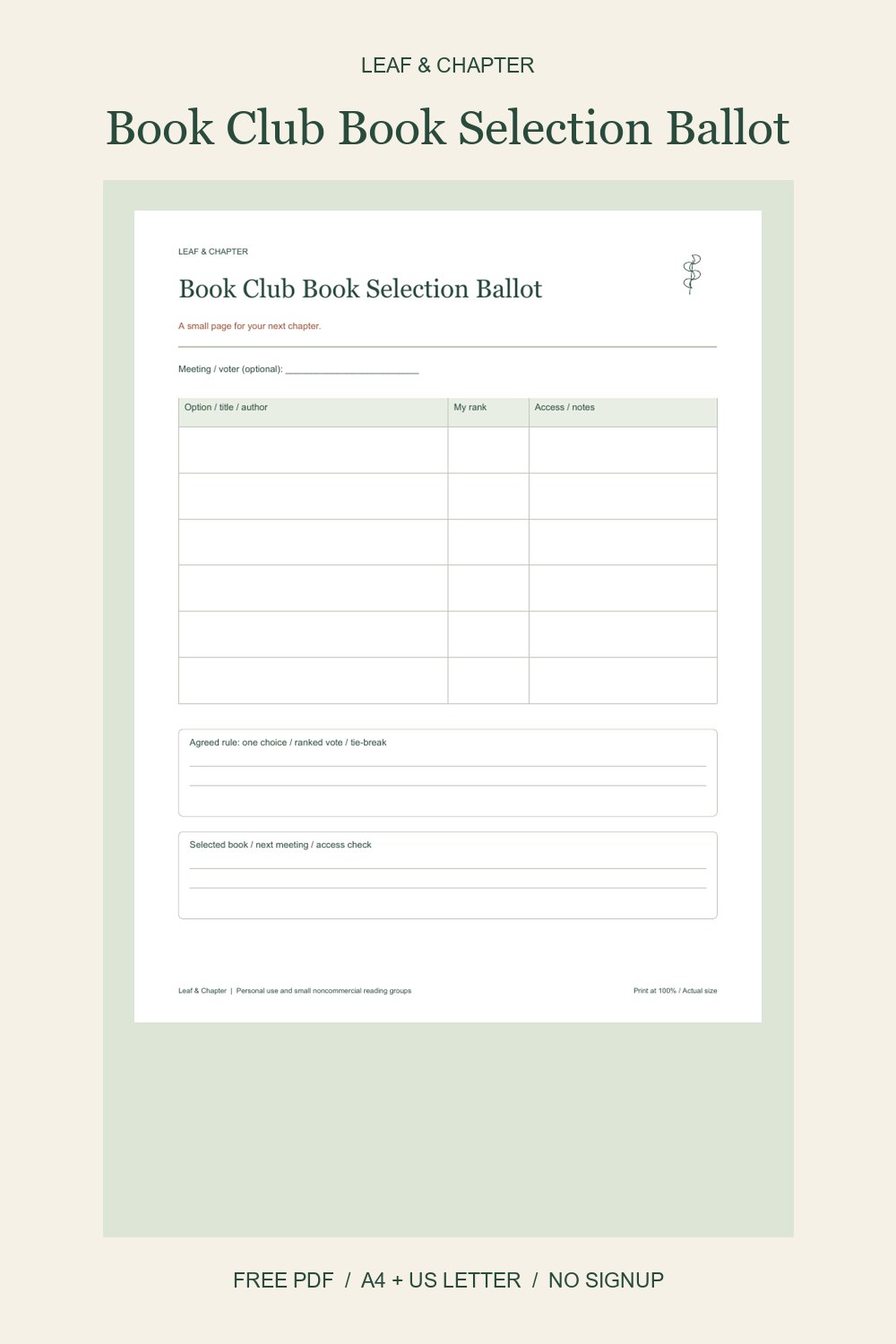
Book Club Book Selection Ballot
Choose the paper size that matches your printer. Both PDFs are free, undated, and made for personal use.
PDF format · No signup · Print at 100% / Actual size
Need a hand? Read the printing guide. These are print-and-write pages, not fillable forms. Personal-use license.
Save it for your
next bookish day.
Keep a link to this page so the printable is easy to find again.
Save to Pinterest ↗A few questions before you print
What is the easiest voting method?
One vote per member from a short list is straightforward. Explain how a tie will be handled before collecting responses.
Should votes be anonymous?
Either approach can work. Tell members which you are using, and avoid claiming anonymity if responses are identifiable.