Start with the information needed to find the book
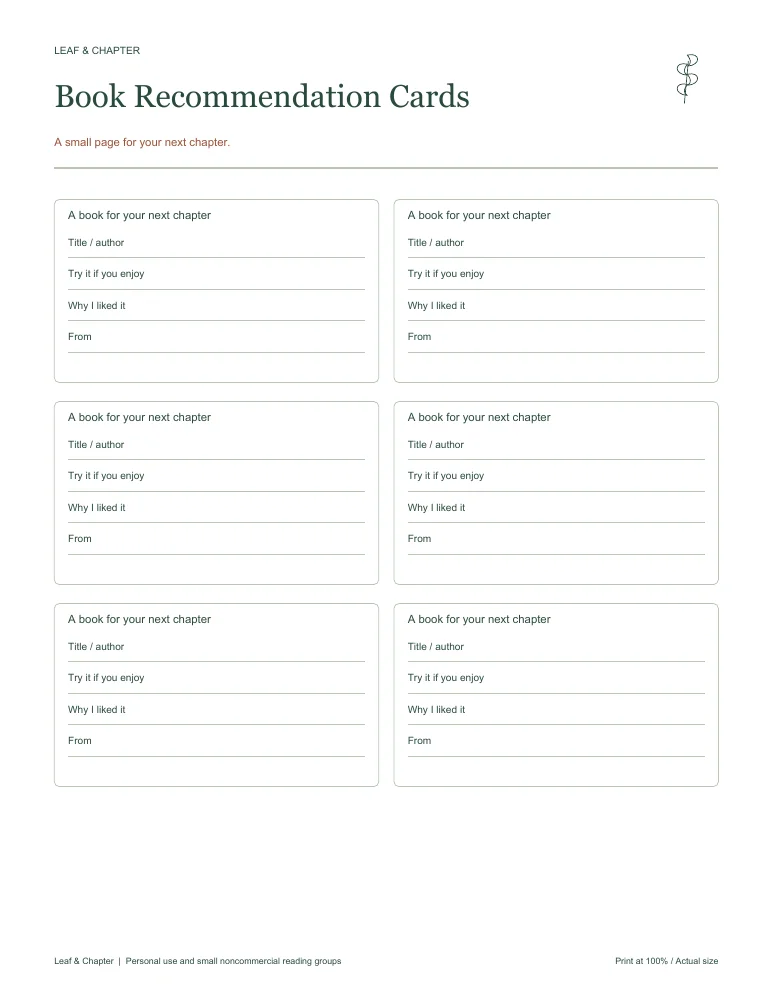
Write the full title and author clearly. Add the series name or volume if the recommendation is not the first book. For a translation, collection, or particular illustrated edition, note any detail that affects the choice. You do not need a catalog entry, but the reader should be able to find the right book without guessing. If you are recommending an audiobook because of its narration, name that format. A recommendation for a performance may not transfer neatly to a print edition with a different reading experience.
Explain the appeal in ordinary language
Try one specific sentence about what you enjoyed. A vivid setting, a clever structure, warm friendships, or a funny narrator gives the recipient more to work with than amazing or must-read. You can mention the pace and tone as well. A slow, reflective book may be a perfect recommendation for one reader and a poor fit for another. There is no need to write a polished review. The card is most useful when it sounds like the explanation you would give across a table to someone choosing their next book.
Connect the suggestion to the recipient
If the card is for a particular person, say why you thought of them. Maybe they enjoy travel writing, asked for a short mystery, or mentioned wanting a story about friendship. Keep the connection respectful and avoid assuming they share every part of your taste. You can write a conditional suggestion such as try this if you like detailed settings. That makes the recommendation easier to assess. For a general swap table, describe the likely reading preference instead of writing as though the book is guaranteed to please everyone.
Keep the plot notes free of surprises
Describe the starting situation rather than the full sequence of events. Avoid revealing the ending or a major twist unless the recipient asks for that information. A phrase about the type of conflict is often enough. If there is material that may affect someone's choice, offer a brief neutral note or suggest checking a reliable content guide. Do not claim your card provides a complete content review. Different readers look for different details, and a short recommendation cannot cover every reason a book might suit or unsettle someone.
Use cards for a book-club swap
Give each member one or two blank cards and ask them to recommend books they have actually read. Place the completed cards beside the books if you are bringing copies, or gather them in a small folder if the books stay at home. Let people browse before choosing. A round of short explanations can add context without becoming a series of speeches. For borrowed books, record lending details separately. The recommendation card explains the choice; it should not be the only place you track who has a personal copy.
Turn incoming cards into a usable list
When you receive a recommendation, decide whether it belongs on your next-up list or your maybe-later list. Add where it came from so you can return to the conversation after reading. If the title does not appeal now, keep it only if you think it may suit another moment. You do not need to accept every recommendation as an obligation. After trying the book, write a short response on the back of the card. That turns a one-way suggestion into a more useful exchange of reading preferences.
Print, cut, and store a small batch
Print one page at the correct paper size and check the margins before making more copies. Use ordinary paper for cards you will tuck into a journal, or a heavier paper your printer supports if they will be handled often. Cut along the indicated edges with suitable scissors or a paper trimmer. Keep a few blanks near your book-club notes or in a drawer with stationery. The cards are intended for handwritten notes, so there is no need to wait until you have a complete set of recommendations before using one.
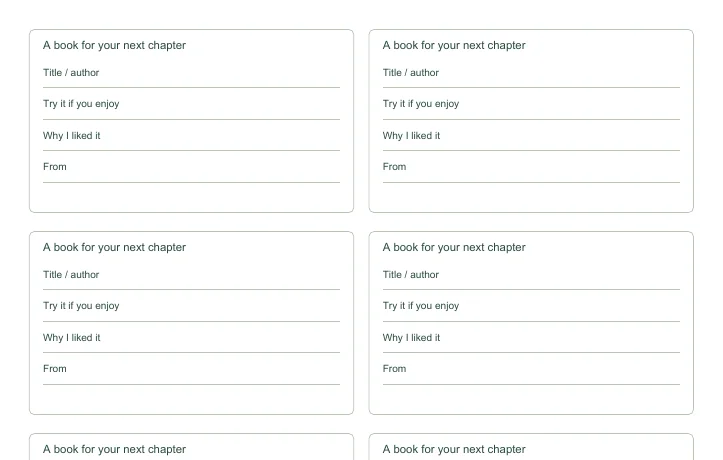

Book Recommendation Cards
Choose the paper size that matches your printer. Both PDFs are free, undated, and made for personal use.
PDF format · No signup · Print at 100% / Actual size
Need a hand? Read the printing guide. These are print-and-write pages, not fillable forms. Personal-use license.
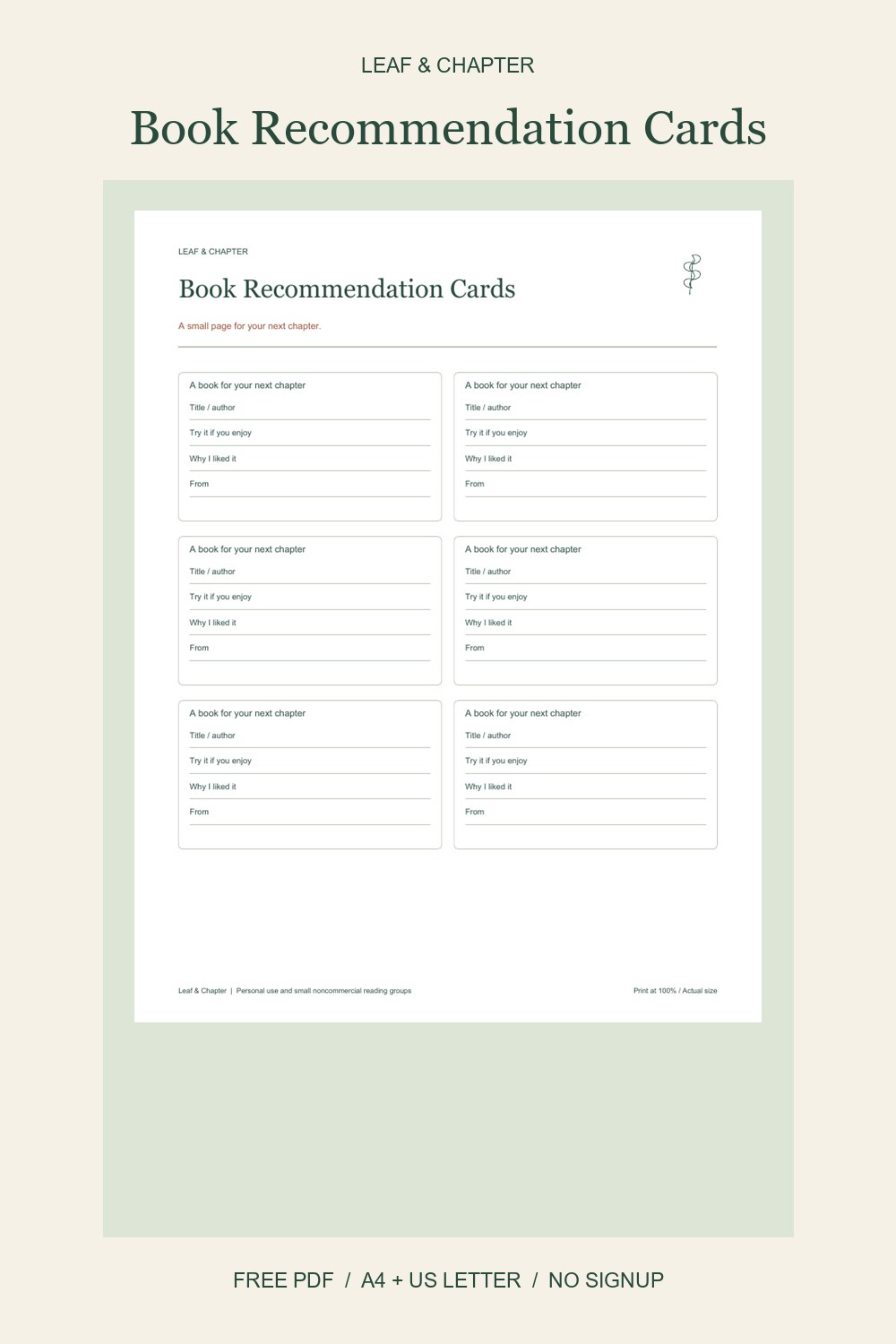
Save it for your
next bookish day.
Keep a link to this page so the printable is easy to find again.
Save to Pinterest ↗A few questions before you print
How much plot should I include?
Give the opening situation and the kind of reading experience. Leave major twists and the ending out unless the recipient specifically wants spoilers.
Can I recommend a book I have not read?
You can share a title you are curious about, but label it that way. A personal recommendation is more useful when it is based on your actual reading.