Choose lines that mean something to you
You do not need to collect the most famous passage or the sentence other readers keep sharing. Choose a line because it surprises you, expresses something clearly, or makes you pause. A funny exchange can belong beside a thoughtful description. A useful quotation is one you want to meet again. If you keep saving entire pages, choose the specific sentence at the center of your interest rather than copying every surrounding paragraph.
Be selective enough that the collection stays readable. You might save one passage from a book, several from a favorite essay collection, or none from a book you still enjoyed. There is no requirement to produce an entry after every reading session. A quotes journal is a collection of discoveries, not a quota. Let the empty spaces wait for something that earns them.
Record the source while it is open
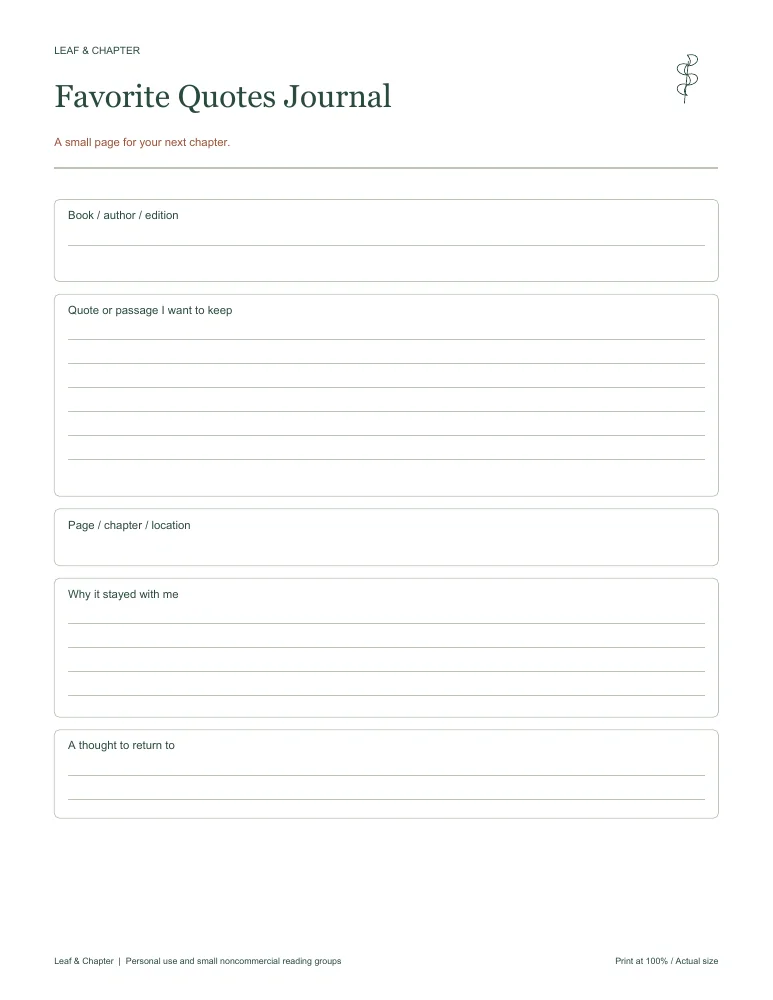
Write the author, book title, and a page number, chapter, or ebook location beside the quotation. Include an edition detail if you need to find the same wording later, especially for translated books. These details are much easier to capture while the source is in front of you. Without them, a lovely line can become a frustrating search when you want to revisit its context.
Check the words before copying them onto the printable. Preserve punctuation when you are recording an exact quote, and use quotation marks so it is clear which words belong to the author. If you shorten a passage or paraphrase it, label that choice. Do not put a remembered approximation in quotation marks. Accuracy matters even in a private journal because your later self may trust the page.
Add the context that makes the line work
A short sentence may change meaning when separated from its speaker or situation. Note whether it appears in dialogue, narration, a letter, or an argument the author later challenges. A fictional character's words do not automatically express the author's opinion. A small context note helps preserve the distinction. You do not need a plot summary. A phrase such as 'said during their argument about leaving home' may be enough.
Then add your own reaction. Explain why you stopped at that line or what it brought to mind. You could write that the description helped you picture a familiar place, that the joke depended on an earlier scene, or that you disagreed with the claim. Your response turns copied words into a personal reading record. It also gives you something interesting to revisit beyond the quotation itself.
Organize only as much as you need
Start with the simplest order: the order in which you find the quotes. You can number the pages and keep them behind a reading log. If the collection grows, add a few broad tags in the notes space, such as friendship, place, humor, or uncertainty. Avoid creating a complicated filing system before you have enough entries to need one. It is easier to notice useful categories after the collection exists.
When you look back, choose a few entries that still interest you and reread the original context if you have access. A line that felt comforting in one season may feel different in another. You can add a dated note rather than replacing your first reaction. Keeping both responses lets the journal show a changing conversation with the books you read.
Print a page and start with one passage
Use the matching paper size, check the print preview, and leave enough room for handwriting. For a first entry, copy a short passage from a book you have available. Add its source, one context note, and two or three sentences about why you chose it. That is a complete entry. Keep the page near your current book so recording a line does not require searching for supplies.
If you later share a journal page online, think separately about the words and your personal notes. A private collection is not permission to republish lengthy passages publicly. Keep public excerpts brief, provide attribution, and check permission requirements for the use you intend. You can also share your own reflection without reproducing the passage. The journal's main purpose is to help you remember and engage with what you read.
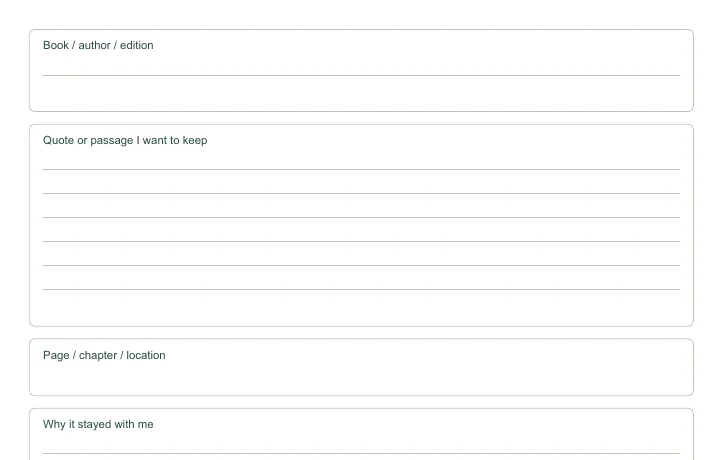

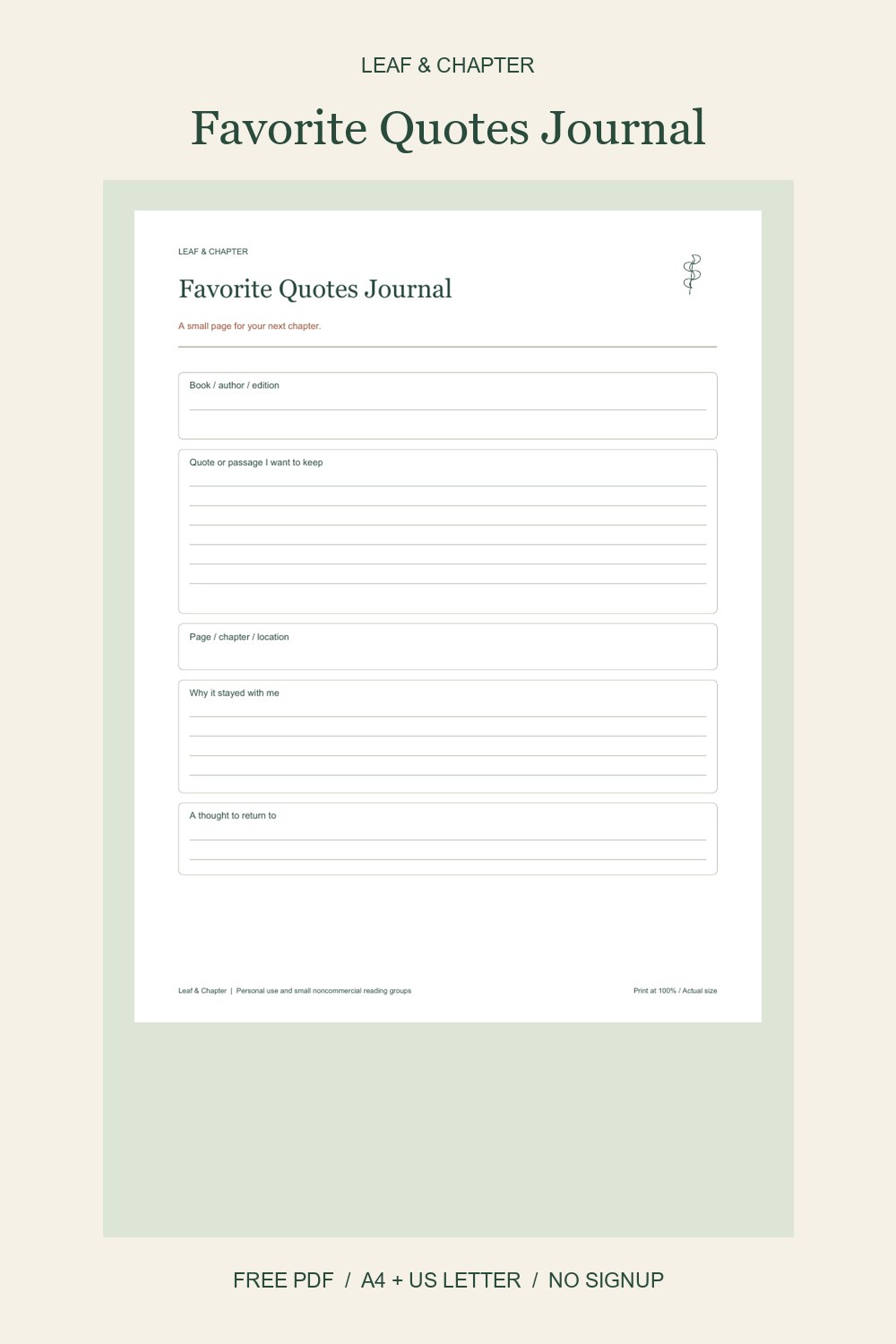
Free Favorite Quotes Journal
Choose the paper size that matches your printer. Both PDFs are free, undated, and made for personal use.
PDF format · No signup · Print at 100% / Actual size
Need a hand? Read the printing guide. These are print-and-write pages, not fillable forms. Personal-use license.
Save it for your
next bookish day.
Keep a link to this page so the printable is easy to find again.
Save to Pinterest ↗A few questions before you print
Can I include my own paraphrase instead of a quote?
Yes. Label it as a paraphrase and record the source. Keep quotation marks for wording you have checked directly against the book.
What if I use an ebook without page numbers?
Record the chapter and location if available. Add a few identifying words from the surrounding section so you can find the passage again.