
1. Give your holiday book club party a simple format
Start by deciding what the gathering is for. If members want to discuss their current selection, make that the main event and treat seasonal details as a backdrop. For an imagined one-hour meeting, allow ten minutes for arrivals, forty for discussion, and ten for the next decision. An optional swap can happen before or after that hour rather than competing with the conversation. Tell guests when the planned meeting ends, even if you are happy for people to linger.
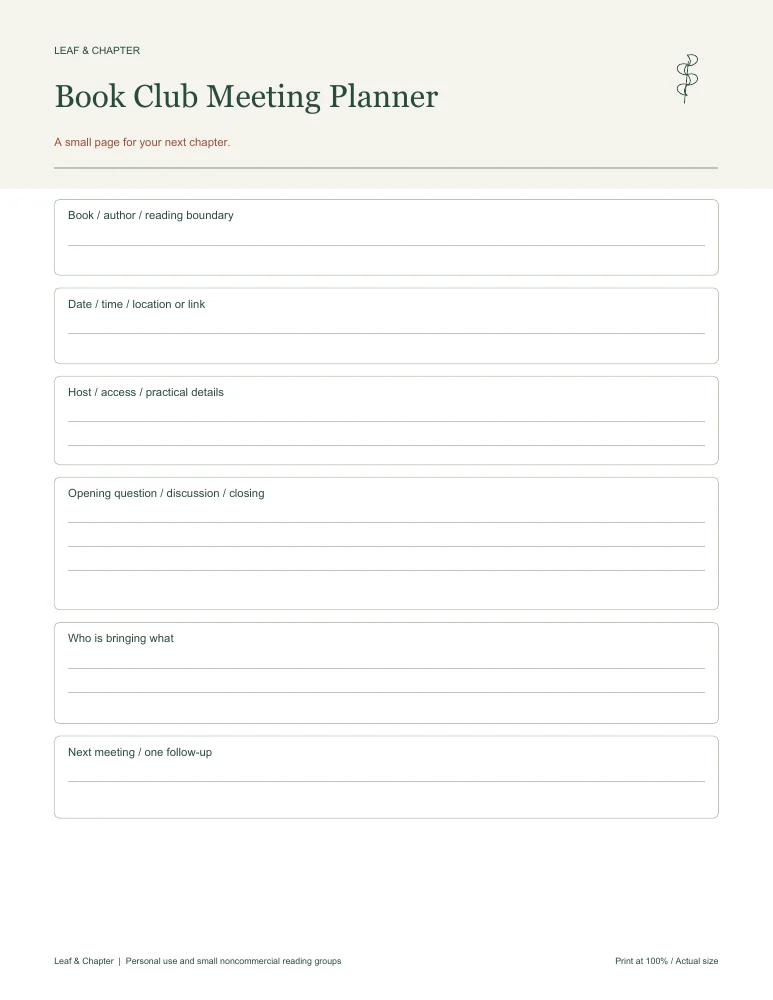
Use the existing Book Club Meeting Planner to record the book, reading boundary, date, time, host, responsibilities, and next steps. Assign a willing person to each task instead of writing “everyone.” Someone might welcome guests while another prepares the opening question. Leave unused areas blank; an empty space is not a job you must create. For an online gathering, include the platform and say when the joining link will be shared.
A table with water, books, and a small seasonal decoration can establish the mood without a demanding theme. A Northern Hemisphere winter meeting might use a lamp and a warm drink; a group that does not celebrate Christmas can simply skip holiday-specific details. Ask privately about access needs, such as step-free entry, quieter seating, or captions.
2. Send a clear invitation and spoiler boundary
Send one message with the title, date, start and expected finish times, location or online arrangements, and the part of the book under discussion. Add entrance or parking information when it matters. If the gathering falls during Christmas planning or another busy period, say plainly that food, gifts, and the swap are optional. Members can then decide how the meeting fits their schedules without guessing what attendance requires.
Set a spoiler boundary people can actually follow. For example: “We will discuss the opening chapters first, then check who wants to continue into the ending.” Identify the chapter where the boundary falls, not only a page number, since editions and audio formats differ. Ask anyone who has not finished what they prefer rather than assuming they want the conclusion revealed. If the group agrees to a full-book discussion throughout, state that before the meeting so guests can make an informed choice.
A useful invitation can be short: “Join us from 7 to 8 for a conversation about the whole book. We will have drinks and a simple snack; no contribution is required. An optional swap follows.” Add a private way to request access or share dietary needs. If a detail is still undecided, name who will follow up and when, rather than presenting a tentative plan as settled.
3. Pick three discussion questions
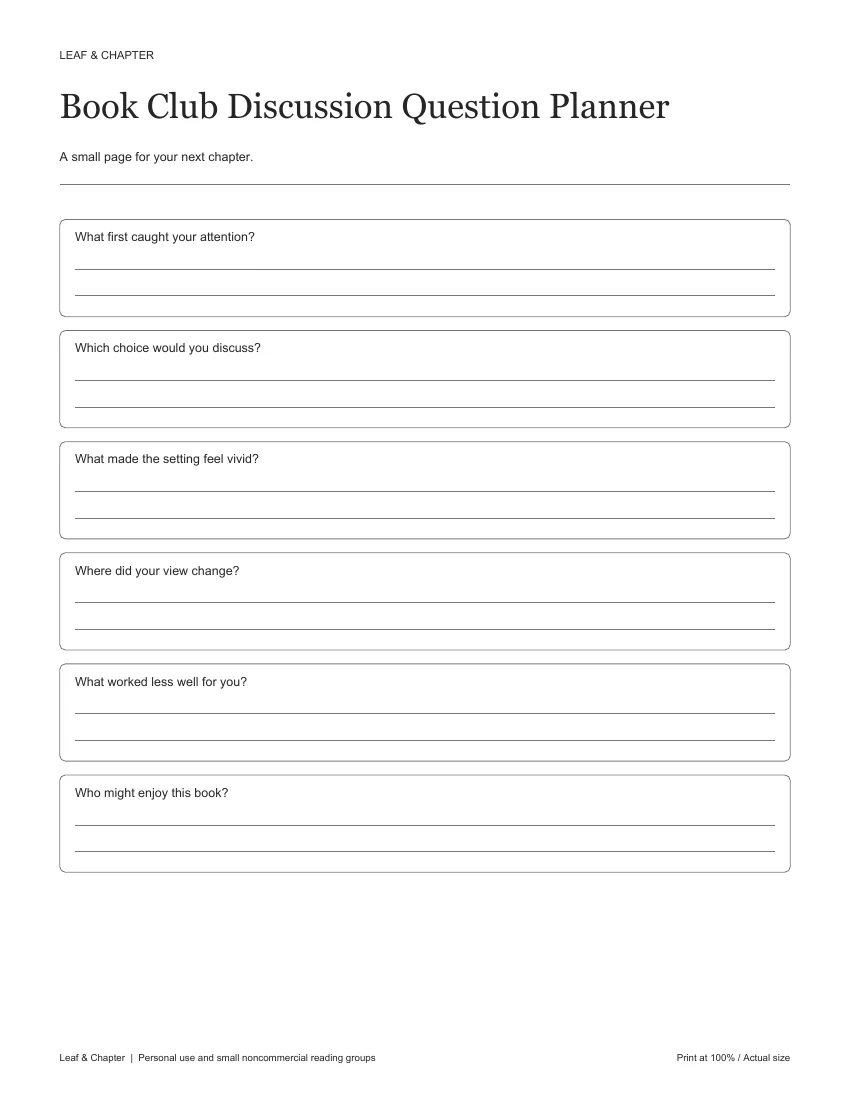
Prepare one easy opening, one question about a choice or argument, and one closing reflection. The existing Book Club Discussion Question Planner helps you choose prompts and note references while leaving room for the conversation to develop. Begin with “Which part held your attention?” rather than asking for an overall verdict. Members can answer briefly, pass, or listen first, including those who read the book some time ago or used audio.
For fiction, ask what a character's decision cost and who bore that cost. Follow with “Did anyone understand that choice differently?” For nonfiction, replace the character question with “Which claim was most convincing, and what evidence shaped your reaction?” A closing question might ask whether anyone's view changed during the conversation. These prompts invite distinct readings without requiring the host to decide which interpretation is correct.
Note a chapter and a brief description of the relevant scene or argument, rather than copying a long passage onto a handout. Keep a question about the ending for the agreed full-book portion. If a topic could feel sensitive, give a short warning and let people discuss the author's choices without sharing personal experiences. Three questions are a starting point, not a quota: a lively exchange about one may be more useful than rushing through all three.
4. Choose manageable snacks
Match refreshments to the meeting, not to an imagined party standard. An afternoon gathering might need water, fruit, and a savory snack; a meeting over dinner needs a clear statement about whether a meal is provided. A seasonal color or familiar winter drink can make the table feel special without requiring a recipe inspired by the book. Keep food and drinks away from borrowed books and devices, and choose items that are easy to serve while people talk.
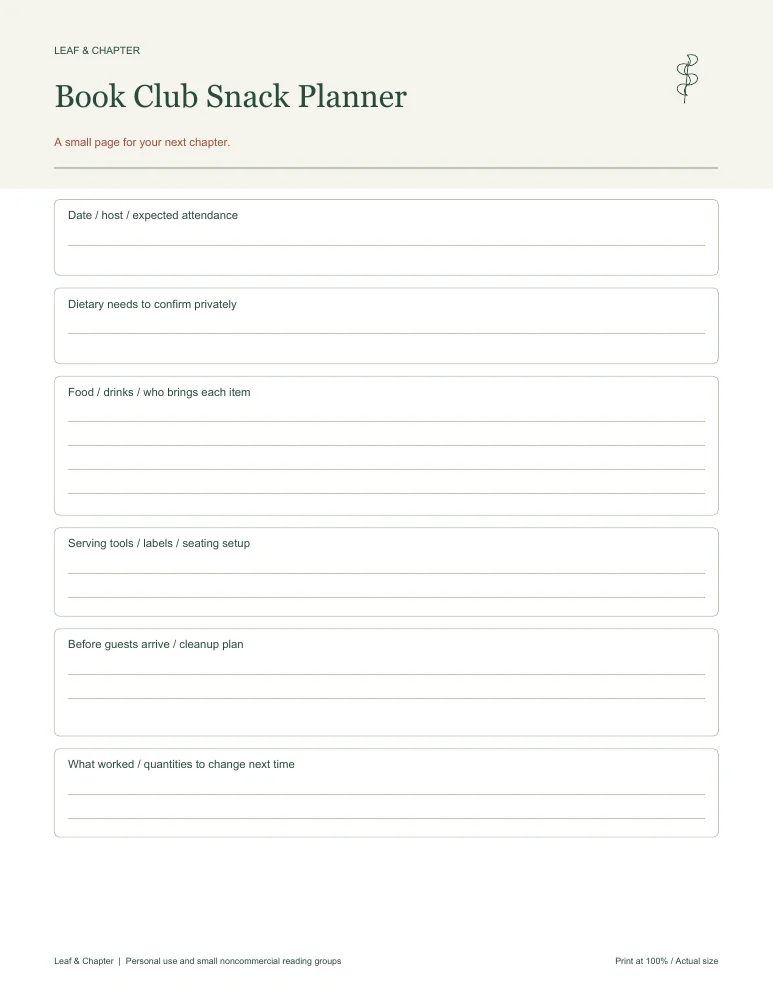
Use the existing Book Club Snack Planner to coordinate attendance, dietary information, contributions, labels, and cleanup. Ask about dietary needs privately before assigning dishes. Keep package labels or ingredient lists available, but do not promise that labels alone make food safe: preparation and cross-contact matter too. Discuss arrangements with the affected guest and respect their choice to bring their own food.
Give willing helpers specific options, such as bringing cups or clearing the table, and keep buying food optional. Check whether any dish needs refrigeration or heating and follow relevant food-safety guidance. For an online meeting, guests can use whatever they already have; a coordinated menu is not necessary. The point is to make conversation comfortable, not to turn refreshments into an entrance fee.
5. Offer an optional book swap
A swap can add a holiday gift-like moment without asking members to shop for presents. Invite guests to bring a clean, readable book they own and are ready to give away, if they wish. Set a small limit that fits the space and explain any genre or audience boundaries in advance. Borrowed and library books do not belong in the exchange unless their owner has explicitly agreed. Anyone who prefers not to bring or choose a book can stay for the conversation.
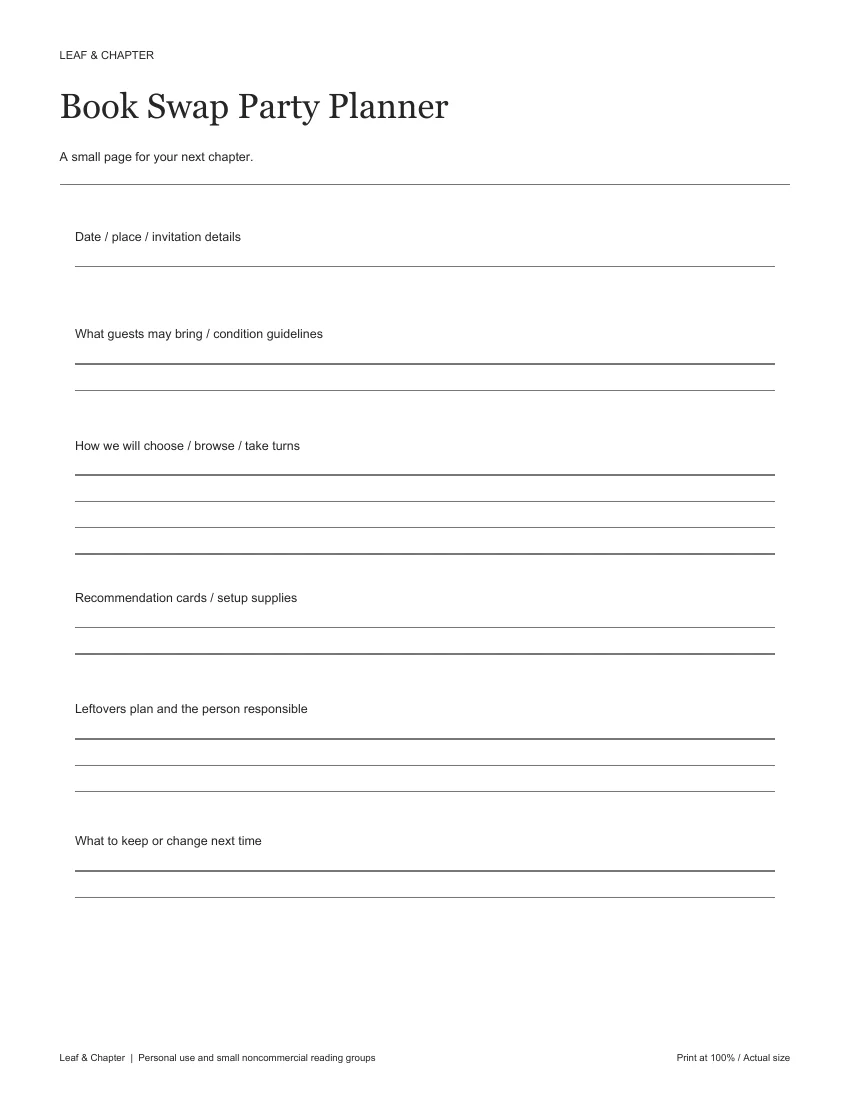
The existing Book Swap Party Planner helps record condition guidelines, choosing rules, recommendation notes, supplies, and the plan for leftovers. For a small group, draw numbers and let each participant choose one book per turn; reverse the order for a second round if there are enough books. If you want people who bring nothing to choose too, set aside extra contributions or open remaining books after the first round, and explain the rule before browsing begins.
Place the swap after the protected discussion time, or let people browse as they arrive without making selections yet. Optional recommendation notes can describe tone or setting without revealing plot turns. Ask contributors whether unclaimed books should return home with them or may be donated, and assign a person to check the recipient's current guidelines. If no destination is confirmed, returning them is a straightforward fallback.
6. Include people who did not finish
A busy season can interrupt reading, and a book club need not become a test of completion. Open with questions about the agreed portion or about the experience of starting the book. Someone who stopped early may have a useful observation about the opening, pacing, or their expectations. Avoid asking them to explain or defend why they did not finish; they may simply prefer to listen or pass.
If members want to discuss the ending, announce the transition and check that everyone knows what comes next. An unfinished reader can choose to stay, step away for the full-book portion, or leave at the announced finish. If several people prefer not to hear spoilers, the group can continue within the shared boundary and arrange a later conversation about the rest. Neither choice needs to be framed as a failure.
Make participation easy across formats, too. Refer to chapters and describe scenes briefly so audiobook listeners and readers with different editions can find their place. An optional round gives quieter members a chance to speak, but do not require a contribution. When disagreement emerges, ask what each person noticed in the text instead of treating recall or reading speed as proof of who is right.
7. Close with a realistic next meeting
Protect the final few minutes for the next decision, then return to any longer conversation after the stated finish. Decide whether to choose a book now or have a volunteer send a short list later. Record the tentative date, the person responsible for the update, and any reading boundary already agreed on in the meeting planner's next steps. If holiday travel or a crowded winter calendar makes a date uncertain, record the follow-up owner rather than forcing a commitment.
Keep reading goals useful and pressure-free. The group might agree to try discussing a shorter section next time, revisit a book they are enjoying, or meet without a fixed completion target. Members can have different personal goals, including no numerical goal at all. Avoid tying praise, gifts, or rewards to book counts; the meeting is for exchanging ideas, not ranking readers.
After guests leave, keep the pages that will genuinely help next time and leave the rest blank. The four linked resources are existing undated printables, not a new seasonal PDF. Each has botanical, minimalist, and ink-saving styles in A4, US Letter, and A5. A decorative style can suit a visible host folder, while an ink-saving version may be preferable for working notes; actual ink use and print quality depend on your printer and settings.
A small checklist before you begin
- Choose the book, meeting location, start time, and expected finish time; record them on the meeting planner.
- Send an invitation stating the reading boundary, access arrangements, and which seasonal extras are optional.
- Select three discussion questions and note relevant chapters without copying long passages.
- Ask privately about dietary needs, then assign any snack or cleanup tasks to willing volunteers.
- If offering a swap, announce book-condition and choosing rules and identify who will handle leftovers.
- Before the meeting ends, record the next decision and the person who will send the follow-up.
Choose the version that fits your day
| Option | Works well for | Keep in mind |
|---|---|---|
| Discussion-first gathering | A group with limited time that wants the book to remain the main event. | Protect the discussion block and avoid filling the remaining time with several activities. |
| Discussion followed by an optional swap | Readers who enjoy exchanging books without making gifts a requirement. | Explain choosing rules and the plan for unclaimed books before the exchange. |
| Shared-boundary discussion | A group in which members have reached different points in the book. | Agree before any ending discussion and let people choose whether to stay. |
| Online meeting with individual refreshments | Members who cannot conveniently reach the same location during a busy season. | Share joining instructions, confirm caption needs, and describe scenes for people using different editions. |
The free pages used in this guide
These are existing, undated resources. Open a resource page to choose its PDF, style and paper size; the lifestyle photograph above is an illustration.
- Book Club Meeting Planner
- Book Club Discussion Question Planner
- Book Swap Party Planner
- Book Club Snack Planner
For the next gathering, return to the meeting planner to capture the practical decisions, use the discussion question planner to prepare a fresh conversation, and consult the printing guide when choosing paper size and printer settings.
A few useful questions
Should we choose a holiday-themed book for the party?
Only if the group wants one. A current selection can support a festive gathering without matching the season. Choose the book for the conversation members want to have, then add a modest seasonal detail if it feels right.
Can we include Christmas gifts without making anyone uncomfortable?
Yes, if gifts are genuinely optional and the invitation makes that clear. An exchange of books people already own is one alternative to shopping. Check that the group wants it, explain the rules, and allow people to attend without participating.
What if the swap takes attention away from the book?
Place it after the announced discussion or allow only informal browsing during arrivals. Tell guests when choosing begins, and keep the swap optional so the host can return attention to the opening question.
Do guests need their own copies of the printable pages?
No. One host can use the existing planners to coordinate the event, and questions can be read aloud. Share or print copies only when they serve a practical purpose, such as helping a volunteer manage the swap.