
1. Begin your year-end reading reflection with what you remember
Prompt: Which book, scene, or reading moment comes to mind before you consult a list? Give yourself a little quiet space and write down the first few fragments, even if you cannot remember a title. A setting, a conversation, or the feeling of reading on a train can be enough to start. Memory is selective, so this is not a test of what deserves to be called your best book. The contrast between what you recall and what appears in your records may be interesting on its own.
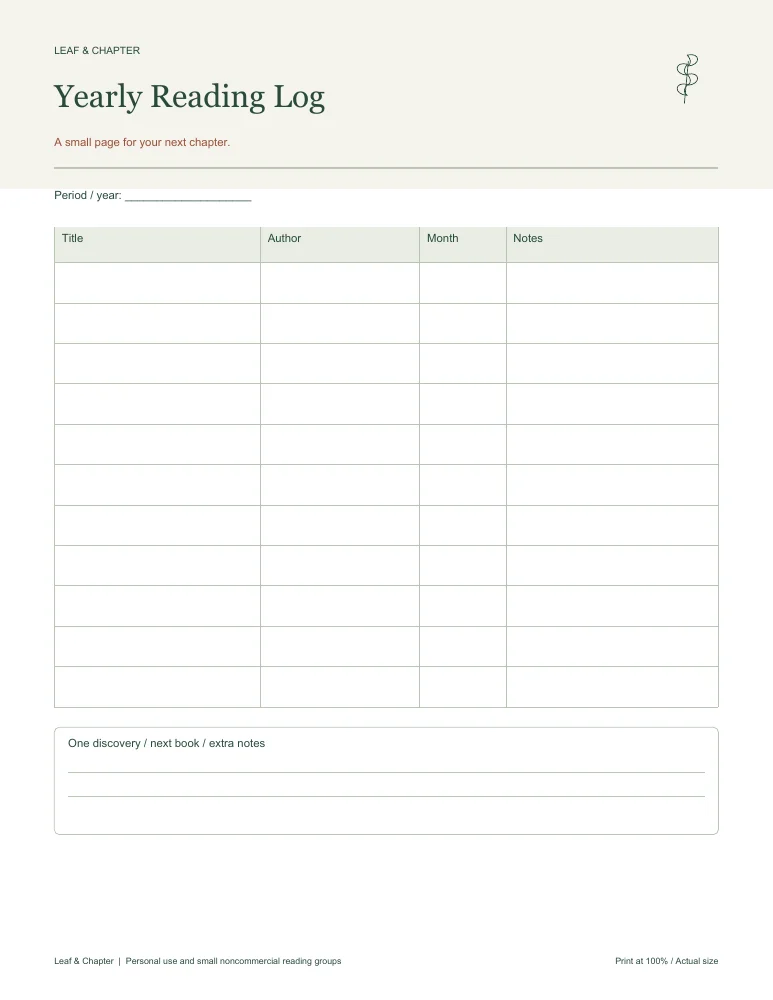
Next, scan your yearly reading log if you have one. Its title, author, finish month, and notes fields provide a broad view; an approximate month is enough when an exact date is unavailable. Circle entries that stir a response, then add a short observation at the bottom or on the reverse. If you have no log, check library history, a bookshelf, or personal notes, but stop when searching becomes a chore. The log is undated, so you can label it with the period you want to review, even if that period did not begin in January.
For a simple reflection session, keep the log beside a blank sheet and make two lists: what surfaced unaided and what the record brought back. Choose one item from either list to explore further. You do not need to recreate missing months, supply forgotten reactions, or fill every line. An incomplete record can still be a useful starting point.
2. Notice the books that changed a question
Prompt: Did a book leave you asking a different question, even if it did not change your mind? Perhaps a novel made you wonder whose perspective was missing from a familiar story, or an essay encouraged you to look more closely at a place you pass regularly. Entertainment and atmosphere are worthwhile outcomes too. If nothing prompted a new question, write about a book that gave you company or simply held your attention.
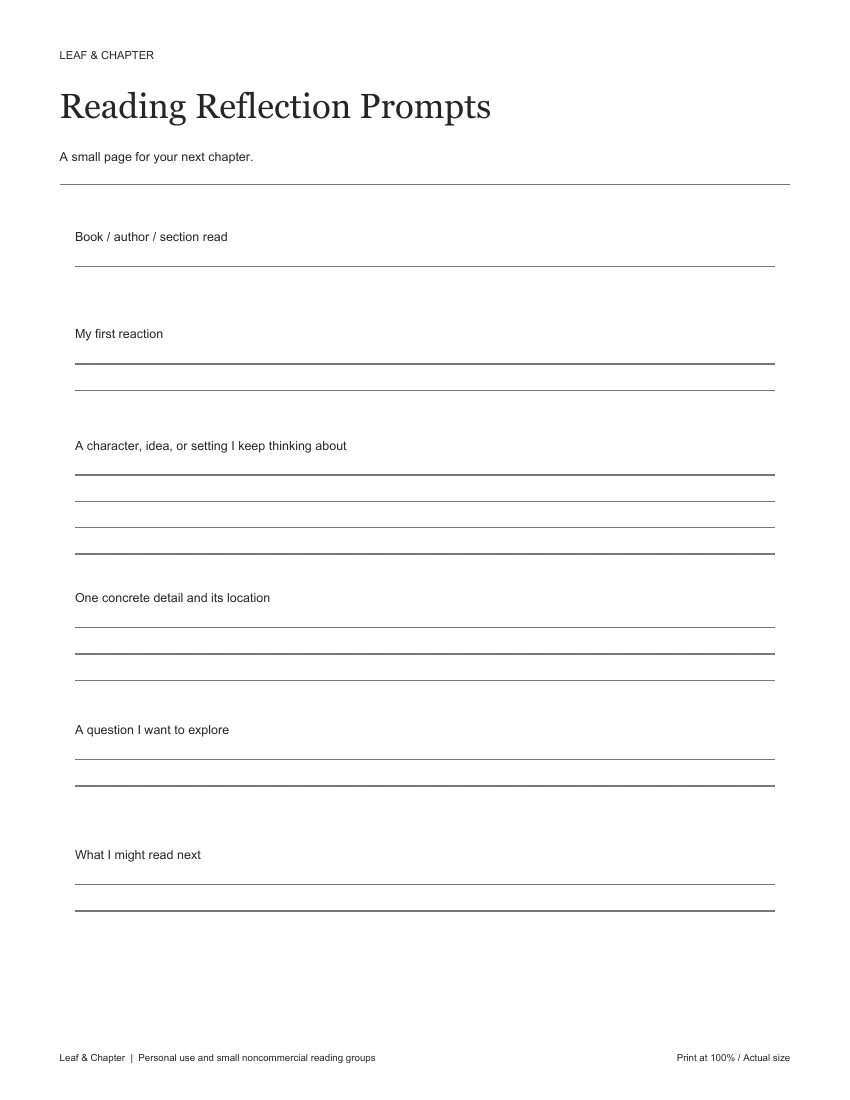
Use the existing reading reflection prompts page for one title rather than trying to cover the whole year. Identify the book and the section read, then pair your reaction with a concrete detail and its location. For example, note a character's evasive answer and the chapter where it occurs, followed by the question it raised for you. A brief description is enough; you do not need a long quotation or a polished review.
Keep your first impression if your view later changes. You can add a dated note beside it rather than replacing it with a tidier conclusion. Leave the next-read field blank if no connection appeals. This page is most useful when it preserves an honest response, including uncertainty, instead of forcing every book into a lesson.
3. Separate finished and paused reads
Prompt: What did you pause, and what would you like to do with it now? A paused book is not necessarily a disappointment. It might have needed more attention than you had available, arrived at the wrong moment, or simply stopped appealing. On a separate piece of paper, make three loose groups: return to, release, and undecided. Add a reason only when it helps you make a choice, such as wanting to restart a complex plot or preferring a different narrator.
Keep finished entries distinct from these notes. The yearly log can record completed books by finish month, while a paused list on the reverse or another sheet keeps the overview clear. For a book begun in December and finished in January, you might use January on the next period's log and note the earlier start if it matters. You do not need to count the same completion twice, and you do not need a total at all.
Before returning a borrowed book, check whether renewal is possible or make a note to request it later. If you own a book you want to release, move it out of your immediate reading stack. Leave the undecided group alone until you are curious again. These are practical choices, not verdicts on your attention or abilities.
4. Compare formats without ranking them
Prompt: When did print, digital reading, or listening fit particularly well? Compare the circumstances rather than deciding which format is superior. You might have enjoyed listening while walking, used an ebook when a room was dark, and preferred print for a book you wanted to leaf through. The same title could suit different formats at different times. If you used only one format, consider what made it convenient rather than inventing a comparison.
Add a format marker in the notes on your yearly log where you remember it. On a separate sheet, make a small list with the format, the situation, and one observation: audio; household tasks; easy to continue while hands were busy. Avoid treating this as a complete audit if your records do not show every format. A few examples can reveal useful possibilities without turning reading into a performance review.
Use the observations for an upcoming choice. If listening helped during travel but you lost track of a complicated cast, a familiar reread might suit the next journey better than an intricate new novel. If a digital sample made starting easy, try that again without promising to finish. Access, availability, and personal preference all matter more than defending one way of reading.
5. Find the patterns in your reading moods
Prompt: What were you looking for when you reached for a book? Browse a few monthly reading wrap-ups if you have them, paying particular attention to mood and what worked. You might notice a desire for familiar stories during busy weeks, curiosity about a subject after a conversation, or enjoyment of short chapters at the end of the day. If you did not keep monthly pages, choose one month you can remember and describe it loosely now.
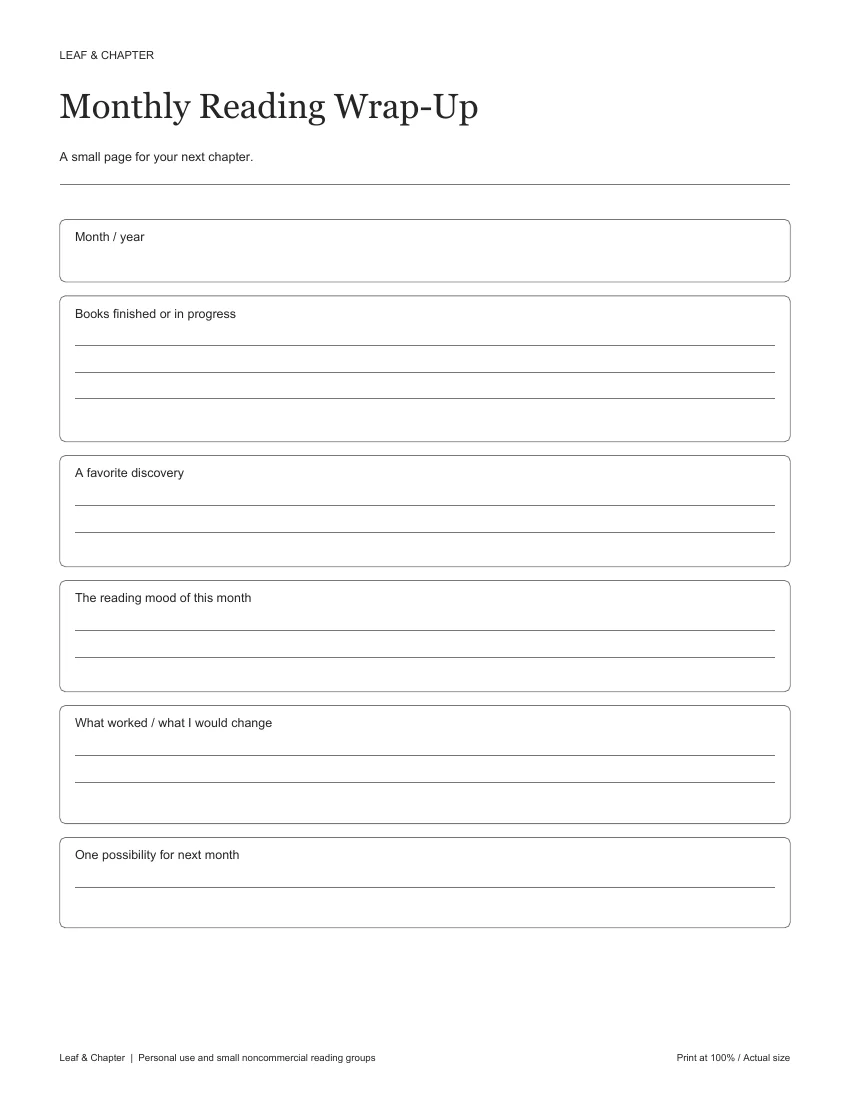
The undated wrap-up has fields for month, finished books, favorite, mood, what worked, and next. Keep started or paused titles out of the finished list; mention them in a note if they help explain the month. A quiet month with no finished books is still worth recording if you want to. You could write that reading time was scarce, leave favorite blank, and note a comfortable place where you opened a book.
Look for a pattern that suggests an experiment, not a permanent identity. Enjoying mysteries for a while does not mean you must keep choosing them. If familiar stories were comforting, place a possible reread beside a new title and choose according to your mood later. In the Northern Hemisphere, a winter evening might offer a natural moment for this review, but the same activity works whenever your reading period ends.
6. Choose recommendations for particular people
Prompt: Which book might suit a particular person's interests, and why? Instead of assembling a universal best-of list, think of someone who enjoys a certain setting, subject, pace, or kind of humor. Write a short, spoiler-conscious note: this might appeal because the story spends time on its seaside community, for example. Include a qualification if useful, such as a slow opening or a format that may be easier to access through their library.
Your reflection page can help you recall the concrete detail behind a recommendation. Check that the reason is about the recipient's likely interests as well as your own enthusiasm. You can also share a question for discussion without expecting anyone to read the book. If planning Christmas gifts, use your notes to consider whether the person would enjoy owning a copy, borrowing one, or receiving a different kind of gift altogether. Check preferences and availability before purchasing.
Sharing can be optional and adaptable. A family or group could each name a memorable story, audiobook, comic, or scene, then pass if they prefer. Keep private notes private and avoid turning the conversation into a contest or attaching rewards to book counts. The point is to offer an opening for conversation, not to assign anyone a reading list.
7. Set one flexible intention for next year
Prompt: What would you like more room for, and what is one small action that could make it easier? Your answer might be to browse more freely, revisit a favorite, try a subject from a different perspective, or keep a book within reach during lunch. A numerical target is optional. If a count helps you plan, choose one that leaves room for long books, rereads, changes of interest, and weeks when reading does not happen.
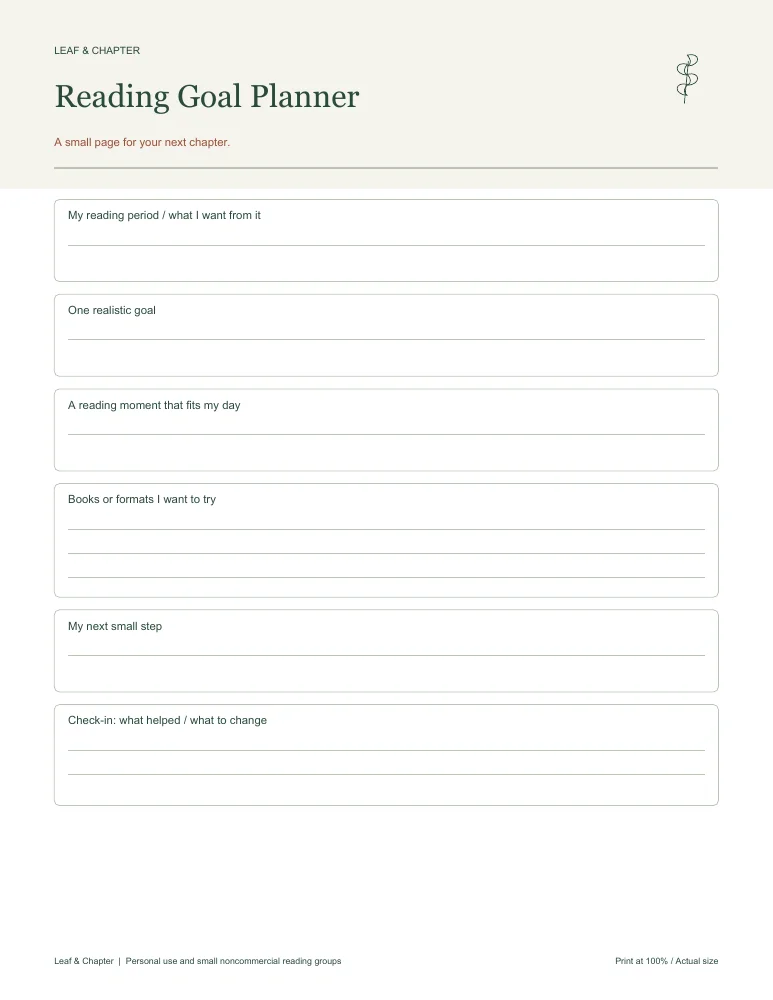
Turn the intention into a trial using the undated reading goal planner. Fill in a period, goal, realistic reading window, relevant book, one next step, and a check-in. For example, choose a month, aim to try a collection of essays, use a quiet lunch as a possible window, and make the next step borrowing the collection. At check-in, ask whether the window and book suited you; change either one or stop the experiment without treating that decision as failure.
Choose a print format that supports the way you will use the pages. A larger sheet gives handwriting more room, while A5 may be easier to keep with a book. Botanical styling adds decoration; minimalist or ink-saving styling offers a quieter page. Actual ink use and print quality depend on your printer and settings. These are existing resources adapted to a seasonal activity, not a new seasonal PDF.
A small checklist before you begin
- Write down a memorable reading moment before opening your records.
- Scan a yearly log or available history and circle a few entries that bring back a response.
- Choose one title and connect a reaction to a scene, idea, or chapter.
- Sort paused reads into return to, release, and undecided on a separate sheet.
- Note one useful reading mood or format situation and one person-specific recommendation.
- Write one flexible next step and choose a check-in point, leaving unused fields blank.
Choose the version that fits your day
| Option | Works well for | Keep in mind |
|---|---|---|
| Yearly reading log | Scanning finished titles and finish months across a chosen period. | Keep paused books separate and avoid reconstructing details you do not know. |
| Monthly reading wrap-up | Remembering a particular month's mood and the practical conditions that worked. | A blank favorite or an empty finished list is fine; do not put unfinished titles under finished. |
| Reading reflection prompts | Exploring one book through a specific reaction, detail, and open question. | Skip questions that do not fit and identify the section if you have not finished. |
| Reading goal planner | Turning one observation into a manageable experiment with a check-in. | Choose a realistic window and revise the plan if circumstances or interests change. |
The free pages used in this guide
These are existing, undated resources. Open a resource page to choose its PDF, style and paper size; the lifestyle photograph above is an illustration.
- Free Yearly Reading Log
- Free Monthly Reading Wrap-Up
- Reading Reflection Prompts
- Free Reading Goal Planner
Explore the yearly reading log for a broad record, the monthly reading wrap-up for reading context, and the printing guide for help preparing pages.
A few useful questions
Can I reflect if I cannot remember when I finished a book?
Yes. Start with what you remember about the book or the circumstances around it. If you use the yearly log, a finish month is enough for its overview; leave uncertain information blank rather than guessing. You can also reflect on a separate sheet without placing the title in a particular month.
What if my strongest memory is of a book I did not finish?
Use it. Note how far you read, what stayed with you, and whether you want to return. The reflection prompts page can hold an early impression, while a separate paused list keeps the title distinct from completed entries on the yearly log.
How can I make this useful when choosing Christmas gifts?
Use a specific response from your notes to match a book to someone's interests, then check whether they prefer owning, borrowing, or another format. Avoid assuming that your favorite will suit everyone, and consider a different gift if you are unsure.
Do I need to print all four resources for one reflection?
No. Start with the page that answers your immediate question, or use paper you already have. A yearly log is helpful for scanning titles, while one reflection page gives a single book more space. Add a wrap-up or planner only if it serves your next step.