
1. Choose an annotation method without writing in the book
Start by deciding what you want your notes to do. If you mainly want to find passages again, a notebook with page or chapter references may be enough. If you want to prepare for a conversation, a loose discussion sheet can put your reactions and questions in one place. If a line catches your attention, a separate quotes page gives you room to record its source and why it matters to you. None of these methods requires marks, adhesive flags, or folded corners in the book.
Choose the least disruptive option for the reading session. You might keep paper beside your chair and jot a reference when you pause, or wait until the end of a chapter and record what you remember. The first approach can preserve precise locations but interrupts reading more often. The second keeps your attention on the story but may require a little searching later. Neither is more serious or more correct.
For an easy starting routine, pick one method for the current book rather than preparing a full system. Record the title and edition, read as usual, and make one note when something genuinely interests you. Add another only if you want to. Your goal can be a useful conversation with the book, not a quota of pages read or notes made.
2. Keep a separate page-reference notebook
A plain notebook works well when you want portable, flexible notes. Begin an entry with the book title, author, and edition or format. For each observation, write a location followed by a short description and your response. For example: chapter 5, the siblings avoid answering a direct question; their silence makes the later disagreement feel less sudden. That is enough to point you back to the scene without retelling it.
Page numbers can differ between editions. Add a chapter or section name when possible, especially if you plan to discuss the book with someone using another copy. For an ebook, use a chapter and an available location, plus a brief description of the surrounding scene. If you cannot identify the place immediately, mark the reference as uncertain and check it before relying on it.
You can use shorthand, but keep it understandable to your future self. A symbol for a question and another for a favorite moment may be useful; a long key can become a task of its own. Leave a little space after an entry if you expect your interpretation to change. A later note beside the first one preserves the development of your thinking rather than replacing it.
3. Use a loose reading companion sheet
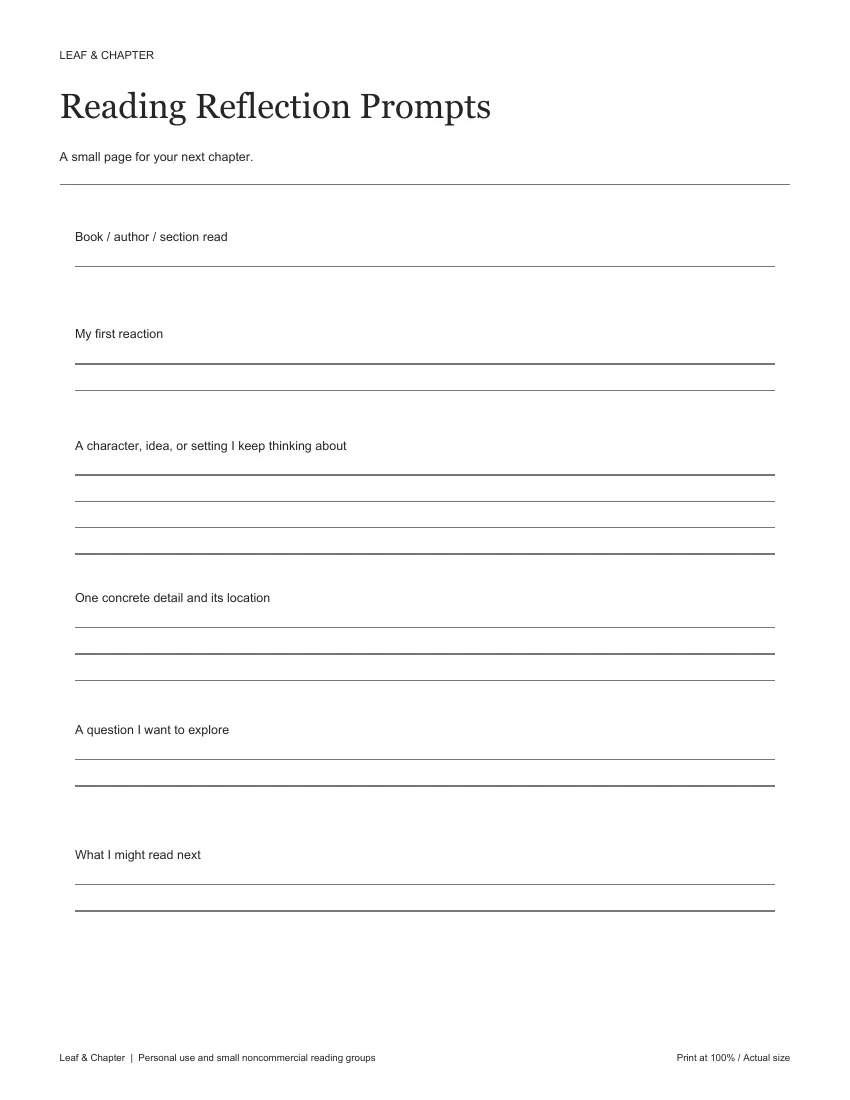
For a more guided alternative, print the existing reading reflection prompts and keep the sheet beside your book or in a folder. Its six fields include the book and section read, a first reaction, a concrete detail and its location, and a question to explore. Choose the prompts that fit your reading; the next-read field can stay blank. Because the sheet is undated, you can start it whenever you begin a book and return to it whenever you wish.
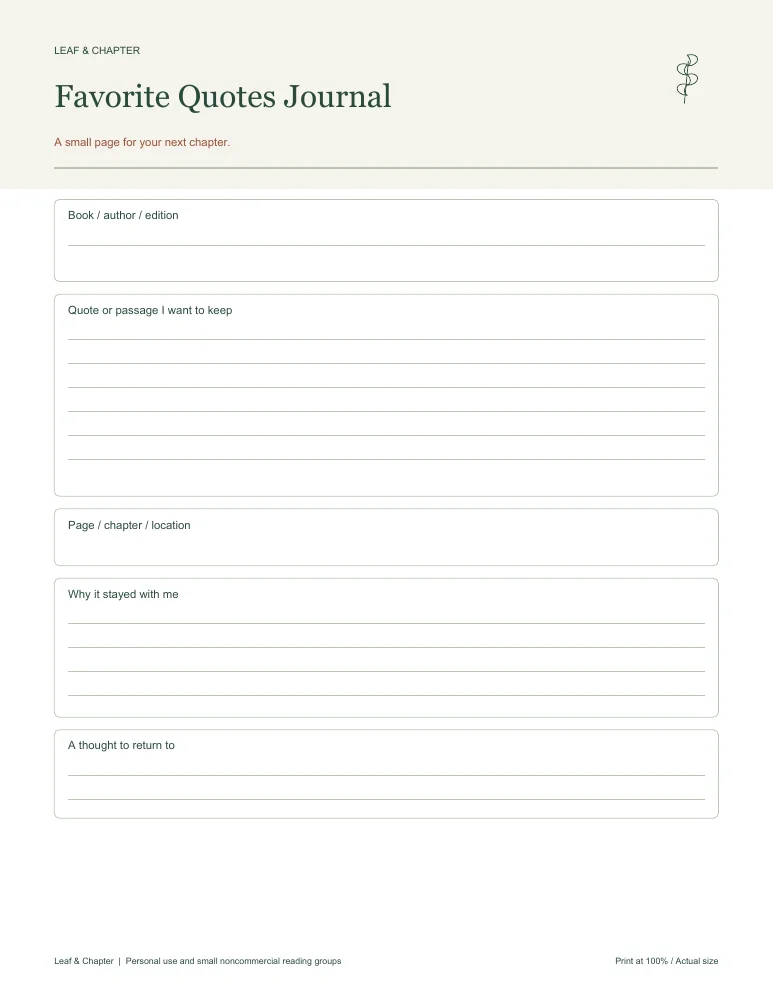
If you are collecting a particular passage, use the existing favorite quotes journal instead. Record the book and edition, location, quotation, why you chose it, and a next thought. Check any copied wording against the source. If you are recording the idea from memory, label it as a paraphrase rather than putting it in quotation marks. A short context note can distinguish a character's statement from an idea the book itself supports.
A4 or US Letter gives handwriting more room, while A5 is easier to carry alongside a smaller notebook. The reflection and quotes pages offer botanical, minimalist, and ink-saving styles. Decoration may make a page pleasant to revisit; a quieter design leaves the focus on your notes. Actual ink use and print quality depend on your printer and settings. Keep the sheet separate rather than assuming a loose insert will be safe inside a borrowed book.
4. Record questions instead of every detail
Questions make useful annotations because they preserve curiosity without requiring an immediate answer. Instead of summarizing a whole chapter, note the decision or claim that made you pause. For a novel, ask what might explain a character's change of plan and record the chapter. For nonfiction, identify an argument you want to examine and note which example raised the question. You can leave the question open when you finish reading.
Try a short pause at a natural stopping point: write one observation, add its location, and turn it into a question if you have one. An observation such as an ending feeling abrupt might become a question about which earlier scene prepared other readers for it. This creates a useful opening for discussion without forcing you to decide that your first response was right or wrong.
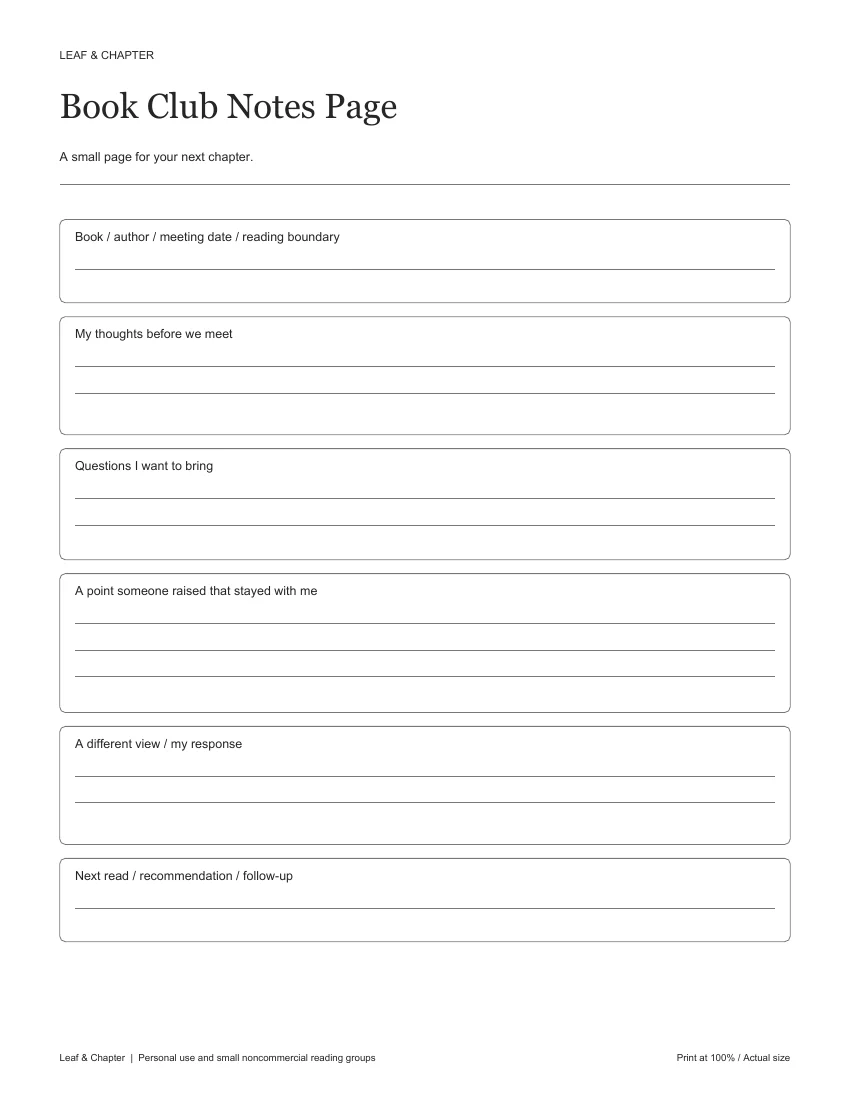
The existing book club notes template can support this approach even if you prefer to prepare quietly before a meeting. Note the reading boundary, your first thoughts, and the questions you care about; leave the discussion and follow-up spaces for later. If you are reading alone, the reflection page is another option. Neither sheet needs every field filled, and a reading session without notes still counts as reading.
5. Handle borrowed books with care
Check the library's or owner's expectations before using any marker in a borrowed copy. Even removable adhesive can affect paper or covers, and slips left between pages can bend them or be forgotten at return time. The simplest low-contact arrangement is to keep your notes in a separate notebook or folder. Use a normal bookmark only if appropriate for the copy, and remove it before returning the book.
Record enough information to find a passage without relying on a physical flag: the edition, page if available, chapter, and a few words describing the scene or argument. Before returning the book, check any quotation against the text and make sure the location is legible. If you discover that a note is vague, add a little context while the copy is still available rather than trying to reconstruct the passage later.
For shared reading, agree on the section everyone has reached before discussing details. Mark a note as a spoiler if it concerns a later revelation, and keep it separate from questions you may share sooner. A family read-along is optional and adaptable: someone can speak an observation while another person writes it down, or everyone can simply enjoy listening. There is no need to compare note totals or tie participation to how many books anyone finishes.
6. Turn rough notes into a short review
When you finish, look over your notebook or companion sheet and circle two observations that still feel useful. Perhaps you appreciated the setting but found the pace uneven, or a nonfiction example made an argument clearer while another left you with questions. Choose one concrete moment for each response. You can describe the moment in your own words rather than copying a passage.
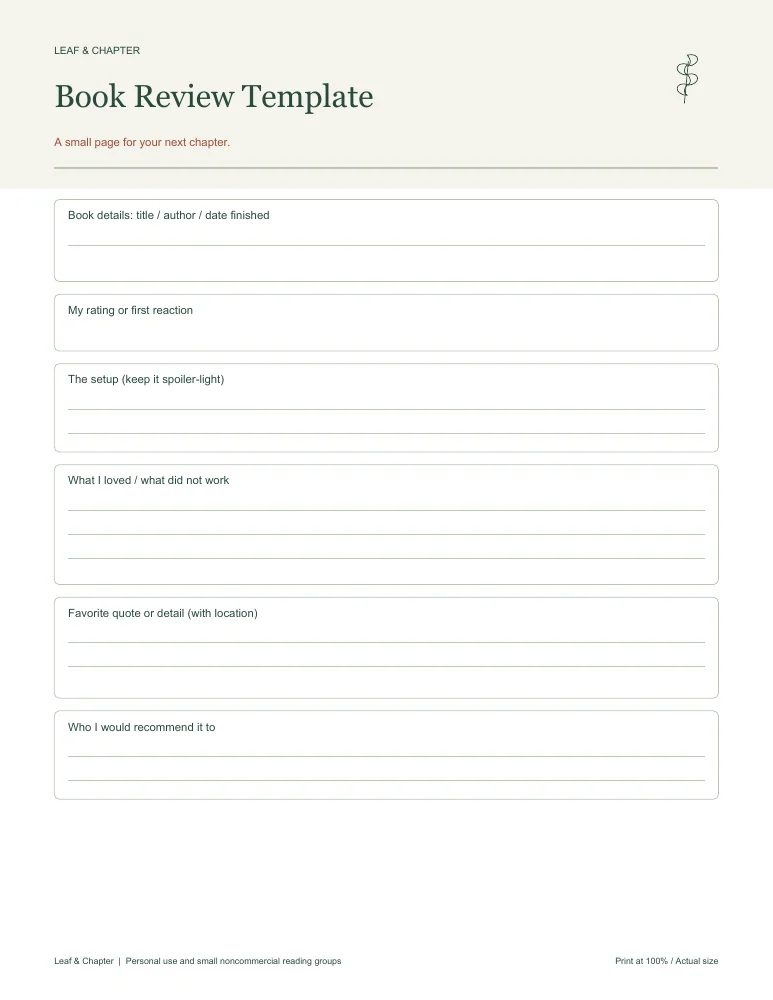
Transfer those choices to the existing book review template. Its separate spaces for setup, reaction, quotation, and recommendation help you keep a brief premise distinct from your opinion. For an imagined village mystery, the setup might identify a missing letter as the central problem; the reaction might explain that shifting alliances held your attention even when some conversations felt repetitive. The recommendation can name a reader who enjoys an unhurried mystery, without promising universal appeal.
A rating and quotation are optional. Leave those spaces blank if neither adds anything, and label major plot revelations before sharing a review. If you stopped reading, identify where you stopped and describe only the portion you know. You can also skip the review entirely: a question and a location in your notebook may be all the record you want from this book.
7. Keep only the notes you will revisit
After reviewing a book, decide where its notes should live. Keep notebook entries in reading order, or place loose sheets in a folder by title. If you used both, write the notebook page on the sheet, or note where the sheet is stored in the notebook. This small cross-reference is often more useful than building elaborate categories before you know whether you need them.
Revisit notes for a reason: before a club meeting, when recommending a book, or when a later reading brings an earlier question back to mind. You might keep the original question and add a dated response after discussion. If another reader offers an interpretation, record the idea in your own words and avoid preserving their private story without permission. A changed opinion and an unchanged opinion can both be worth noting.
Let the system shrink when it stops serving you. Recycle rough copies you do not want, keep a single reflection page, or pause note-taking for your next book. The printables are optional tools for a flexible reading practice, not a collection you need to complete.
A small checklist before you begin
- Choose a separate notebook or one existing printable for your current book.
- Record the title, author, and edition or reading format before making your first note.
- Add a page, chapter, section, or available ebook location beside an observation.
- Write one open question at a natural stopping point, leaving it unanswered if you prefer.
- Check copied wording against the book and label remembered ideas as paraphrases.
- After reading, keep the notes you may use and file or recycle the rest.
Choose the version that fits your day
| Option | Works well for | Keep in mind |
|---|---|---|
| Separate reference notebook | Flexible observations and locations across several books. | Shorthand or page numbers without edition details can become hard to interpret. |
| Reading reflection prompts | A guided response to a book or a clearly identified section. | Not every prompt will fit; leave fields blank rather than inventing answers. |
| Favorite quotes journal | A passage you want to preserve with its source, context, and your reaction. | Check exact wording and distinguish paraphrases from quotations. |
| Book club notes template | Questions before a discussion and a record of an idea you want to revisit afterward. | Respect the group's reading boundary and keep private disclosures out of shared notes. |
The free pages used in this guide
These are existing, undated resources. Open a resource page to choose its PDF, style and paper size; the lifestyle photograph above is an illustration.
Build a flexible collection with the reading journal kit, explore the reading reflection prompts, and consult the printing guide when choosing paper size and settings.
A few useful questions
How can I find a passage again if someone else has a different edition?
Record the chapter or section as well as your own page number. Add a brief description of the scene or argument so another reader can locate it in context. Page numbers alone may not transfer between editions.
What should I do if taking notes interrupts the story?
Wait until a chapter break or the end of your session, then jot down only what remains interesting. You can search for an exact location later, or leave the reference approximate and clearly label it as uncertain.
Can I annotate an audiobook without pausing constantly?
Yes. At a convenient stopping point, note the chapter and an available timestamp or section reference, along with a brief description of the moment. If you want exact wording, return to the recording to check it rather than treating a remembered phrase as a quotation.
What if my notes reveal the ending but I want to share a review?
Separate the private notes from the version you share. Describe your response without the reveal, or clearly label a later section as containing spoilers so readers can decide whether to continue.