
1. Give your first book club meeting a clear purpose
Before sending invitations, decide whether the first gathering is a planning meeting or a discussion of a book everyone has already had a chance to obtain. A planning meeting can be the easier start: people can join without advance reading, compare preferences, and help shape the club. Say so in the invitation, along with the date, location or online format, expected finish time, and any access information already available.
Give the meeting a small outcome rather than a long list of activities. For example, aim to agree on how to choose the first book, identify a possible meeting window, and name someone to send the follow-up. If the choice needs more checking, that is a useful outcome too. The group can leave with a person responsible for checking library and format availability instead of rushing into a title.
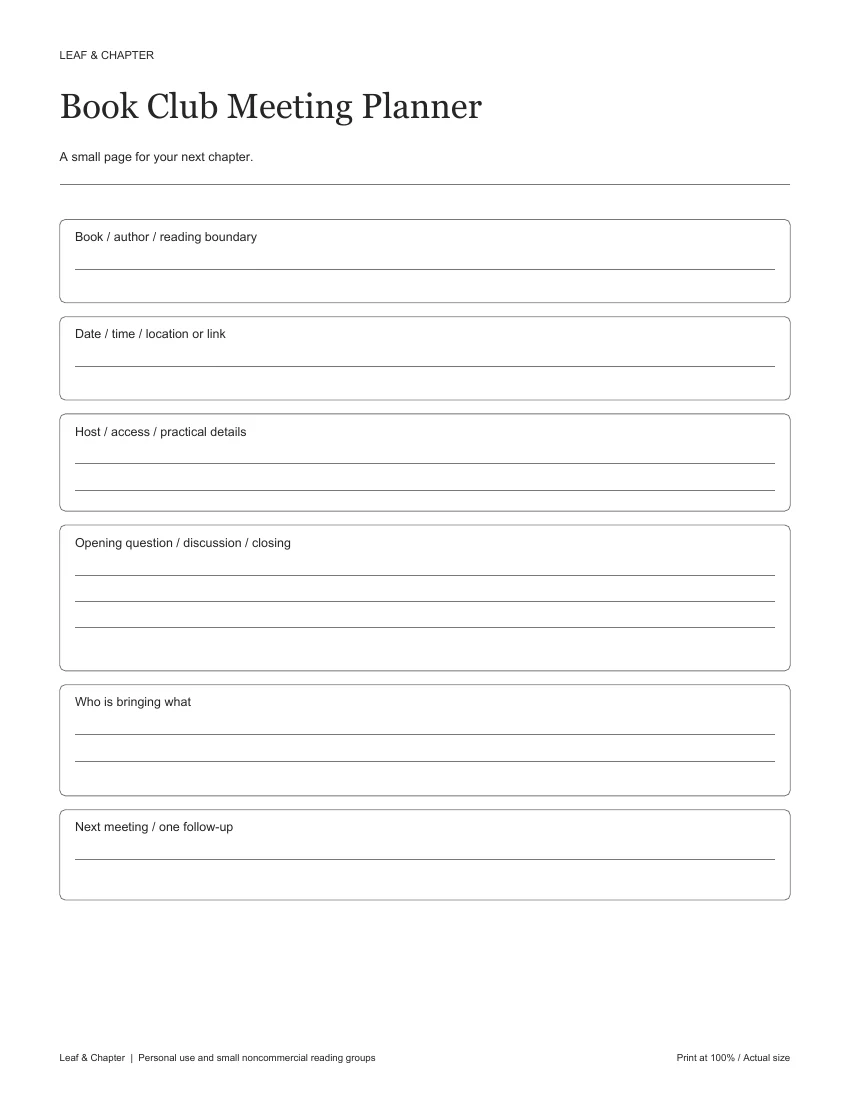
The existing book club meeting planner can hold the outline, responsibilities, questions, and next steps. Sketch an arrival period, a preferences conversation, and time for decisions, while protecting room for people to talk. For a one-hour gathering, one option is ten minutes for arrivals, twenty for preferences, twenty for choices, and ten for the next step. Treat the timings as a guide, not a test.
2. Ask about access and reading preferences
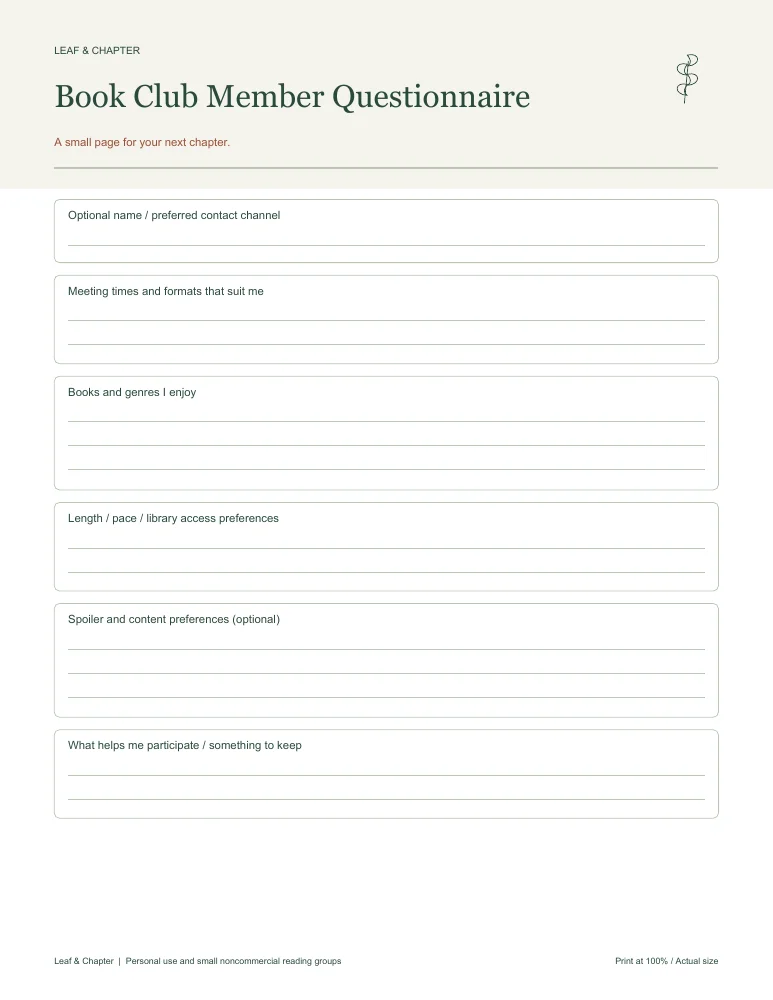
Invite members to complete the existing book club member questionnaire before the meeting or during a quiet moment at the start. It covers meeting times, genres, length, pace, and optional spoiler and access preferences. Explain who will see the answers and how they will inform the shortlist. Do not call the process anonymous if names or handwriting could identify people, and let anyone leave a question blank.
Look beyond genre when you discuss the responses. A member might enjoy a suggested novel but need an audiobook, while another might prefer an ebook from a library. Ask separately what would help people attend, such as captions online, step-free entry, or a quieter room. People do not need to explain why they are making a request. If someone wants to discuss a preference privately, offer a channel for that rather than asking them to share it with the whole group.
Summarize patterns without repeating identifiable details: perhaps several people want shorter books, or weekday evenings work better than weekends. Preferences are starting points, not permanent labels. Invite members to suggest genres they might enjoy trying, and allow a person to skip a particular book without giving a reason. If sensitive content matters to the group, offer advance information when reliable details are available, while acknowledging that screening can miss things.
3. Agree on a fair way to choose books
Turn the preferences into a manageable shortlist rather than opening an endless nominations thread. Three possible books can give a new group meaningful choice without taking over the meeting. For each, share the title, author, a neutral description, rough length, and relevant format availability. Check library access and expected waiting times where possible. A popular choice is not yet a practical choice if members cannot obtain it in time.
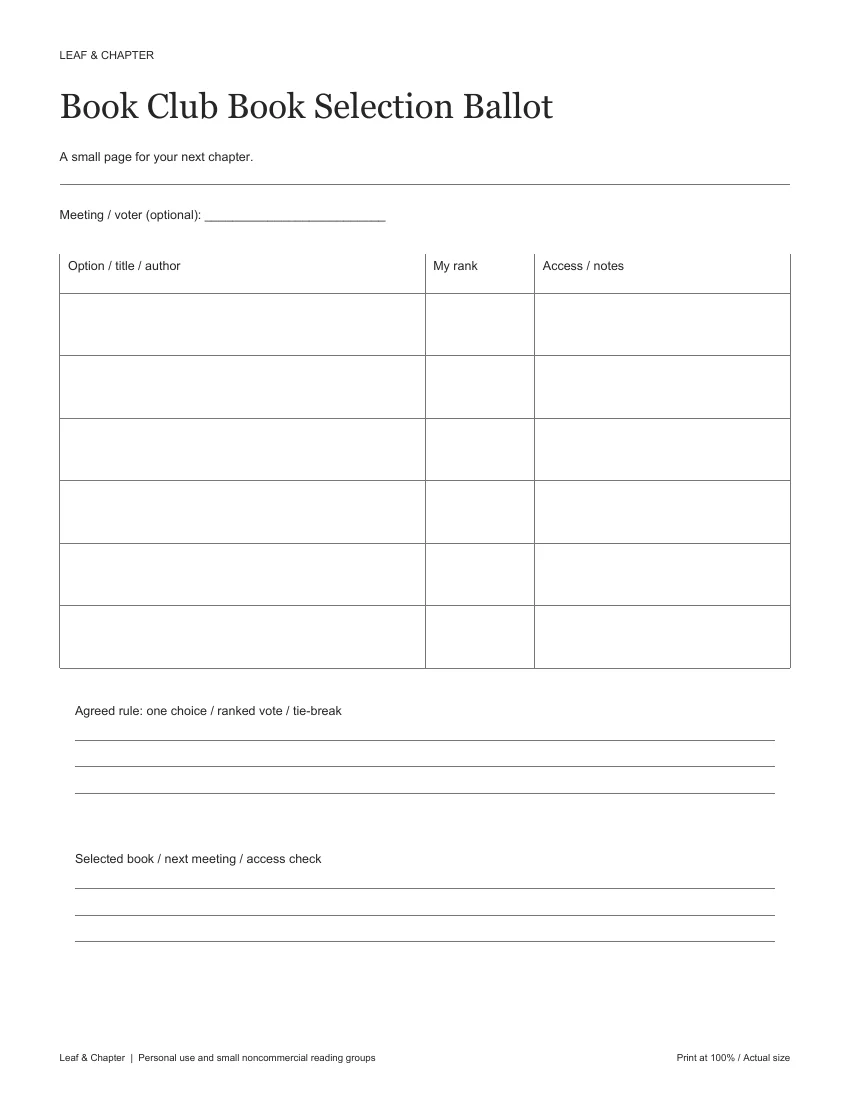
Use the existing book club voting ballot to keep the choices and agreed rule together. It has room for six candidates, ranks, access notes, rules, the winner, and the meeting date; a shorter list and unused rank spaces are fine. A straightforward rule is one vote per member, with the most votes winning. Decide before voting what happens in a tie, such as a runoff between the tied books.
Give absent members a chance to respond by an agreed deadline and choose one collection point so replies are not counted twice. If someone changes a vote, replace the earlier response rather than adding another. Confirm access again before announcing the winner. If availability has changed, explain the problem and use a fallback the group agreed on, such as adjusting the date or considering the runner-up. Keep other nominations for a future round if their suggesters wish.
4. Set a realistic reading calendar
Once a book is selected, work backward from a possible discussion date. Allow time to obtain it as well as time to read it, and ask whether the interval feels workable before calling it final. A short, readily available book may suit an early meeting; a longer book or one with a library queue may need a later date. Reading goals can be flexible intentions, not obligations to prove progress.
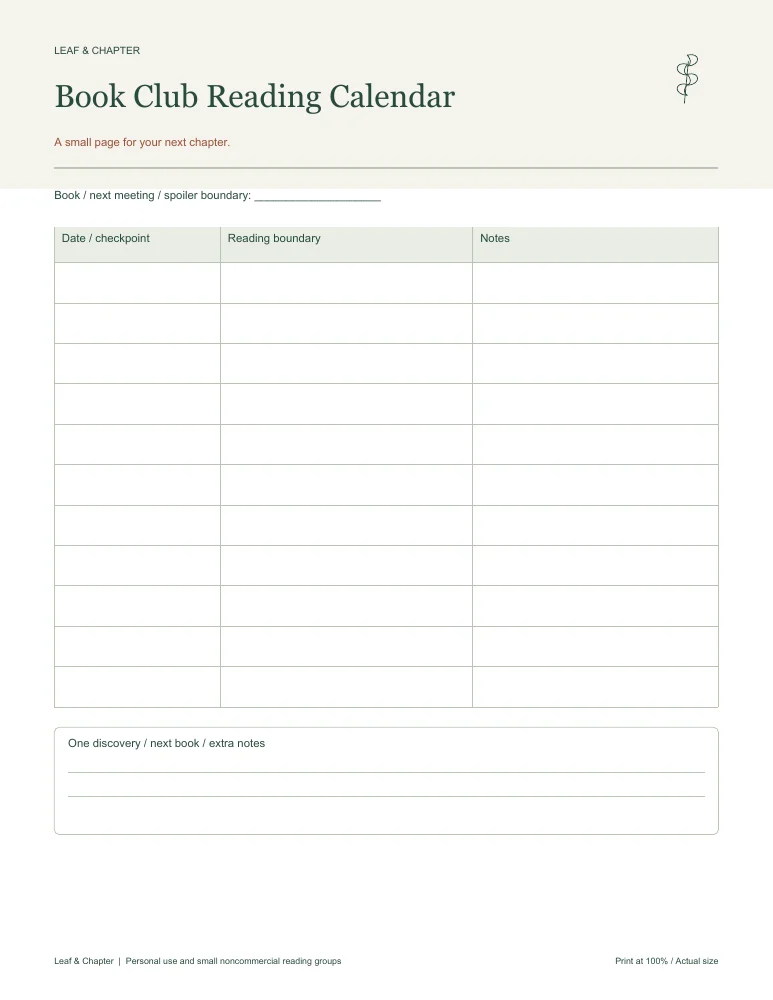
The existing undated book club reading calendar offers Date / checkpoint, Reading boundary, and Notes columns. Record the discussion date and the agreed boundary; add an optional checkpoint only if members want one. Use a chapter or named section instead of relying solely on page numbers, since print editions, ebooks, and audiobooks do not always align. For instance, the boundary might be the end of chapter eight, with a note that an optional check-in should stay spoiler-light.
Agree on unfinished reading before it becomes awkward. Members might attend to discuss the opening or simply listen, with a clear warning before the ending is discussed. Alternatively, the group can postpone a full-book conversation. Share the decision and any date changes in the usual group channel: a paper calendar is a reference, not an automatic notification. Keep private joining links and contact details in that channel rather than circulating them on a printed page.
5. Try a small discussion round
A planning meeting can still give people a feel for the conversation. Invite each person, if they wish, to mention a book they enjoyed and one feature that worked for them, such as its setting, pace, or point of view. Make passing or listening an ordinary option. The aim is not to produce recommendations everyone must read; it is to practice sharing different responses without needing to defend a favorite.
If members have already read the same book, begin with an open question within the agreed spoiler boundary: which moment stayed with you, and what made it memorable? Follow with a question about a character's choice or the author's approach. Avoid turning the round into a quiz with a correct answer. A facilitator can invite other perspectives when one voice dominates, then leave a pause rather than immediately filling the silence.
Two or three prompts are enough to start. Note them in the meeting planner and leave room for an unexpected idea from the group. If the conversation moves toward a later plot point, remind everyone of the boundary before continuing. A group that welcomes different interpretations and allows people to pass has a useful foundation, even if it has not reached a complete consensus about the book.
6. Divide the hosting work
Hosting can mean coordinating the gathering, not providing everything personally. Use the meeting planner's responsibilities area to match specific tasks with willing people: one person confirms the room or call, another prepares an opening question, and another sends the reminder. Give each agreed task one owner and check that they are comfortable with it. A clear assignment is more useful than assuming everyone will remember a general request for help.
Keep the plan accessible and affordable. Water and a place to sit may be enough for an in-person gathering; elaborate food, decorations, and themed supplies are optional. A member can help by welcoming arrivals or tidying up rather than purchasing anything. If the group considers an optional shared cost, explain it before asking for agreement and make opting out straightforward.
Choose a printable format for the way you will use it. The planner is available in botanical, minimalist, and ink-saving styles, in A4, US Letter, and A5. A larger page can leave more room for handwriting, while A5 may be easier to carry; the ink-saving style is worth considering for a plain working copy. Actual ink use and print quality depend on the printer and settings. See the printing guide if you need help preparing a copy.
7. Write down the next step
Close by reading back only the decisions the group has actually made: the selection method or chosen book, the tentative or confirmed date, the reading and spoiler boundary, and who will send the update. Put the immediate action and its owner in the meeting planner's next steps. If a decision is still open, write the question and who will check it rather than filling the space with a guess.
Afterward, send one concise message that reaches members who could not attend. Include the book title and author if confirmed, the meeting details, how to obtain joining information, and when members can expect any outstanding availability check. A sample action might be: the coordinator will check audiobook access and report back before the ballot closes. Avoid forwarding individual questionnaire responses unless members agreed to that use.
Keep only the pages that serve the group. The questionnaire can inform a private summary, the ballot can record the selection rule, the calendar can carry the reading boundary, and the planner can guide the gathering. These are existing resources being combined for a first-meeting activity, not a new meeting kit.
A small checklist before you begin
- Invite members to a planning meeting and state the expected finish time.
- Share the member questionnaire with optional answers and explain who will see them.
- Check format and library availability for a short, neutrally described list of books.
- Agree on a voting rule, tie procedure, response deadline, and single collection point.
- Record the meeting date, reading boundary, and spoiler approach on the undated calendar.
- Assign one person to send a recap and name an owner for each outstanding task.
Choose the version that fits your day
| Option | Works well for | Keep in mind |
|---|---|---|
| Member questionnaire | Gathering preferences about reading, timing, and access before building a shortlist. | Do not require sensitive answers or share individual responses beyond the agreed purpose. |
| Voting ballot | Giving members the same shortlist and a visible selection rule. | Rank spaces do not specify a counting method; agree on the method and tie procedure first. |
| Reading calendar | Recording dates, optional checkpoints, and reading boundaries across different editions. | Update the group separately when plans change; the printed page cannot send reminders. |
| Meeting planner | Keeping the agenda, discussion questions, responsibilities, and next steps together. | Do not fill every space or give the host all the work simply because the page has room. |
The free pages used in this guide
These are existing, undated resources. Open a resource page to choose its PDF, style and paper size; the lifestyle photograph above is an illustration.
- Book Club Member Questionnaire
- Book Club Meeting Planner
- Book Club Book Selection Ballot
- Book Club Reading Calendar
Continue planning with the member questionnaire, make the selection transparent with the voting ballot, and keep the next gathering manageable with the meeting planner.
A few useful questions
Can the first meeting happen before we have chosen a book?
Yes. Make it a planning gathering: discuss preferences and access, agree on a selection process, and decide who will follow up. Tell invitees that no advance reading is expected.
What if members want very different kinds of books?
Use a varied shortlist and a clear vote for the first selection, then consider rotating genres later. A questionnaire can reveal interests, but it does not need to lock anyone into a single category.
How can an absent member take part in choosing the first book?
Send the same shortlist, access notes, voting rule, and deadline to everyone. Accept the absent member's response through the agreed collection point and count only one response per person.
Should we postpone if someone has not finished the selected book?
Ask the group what it prefers rather than assuming. You could discuss the opening first and warn before ending spoilers, or move the full-book conversation. Members can also attend and listen without explaining their progress.